
Understanding the System Behind Life-Altering Harm
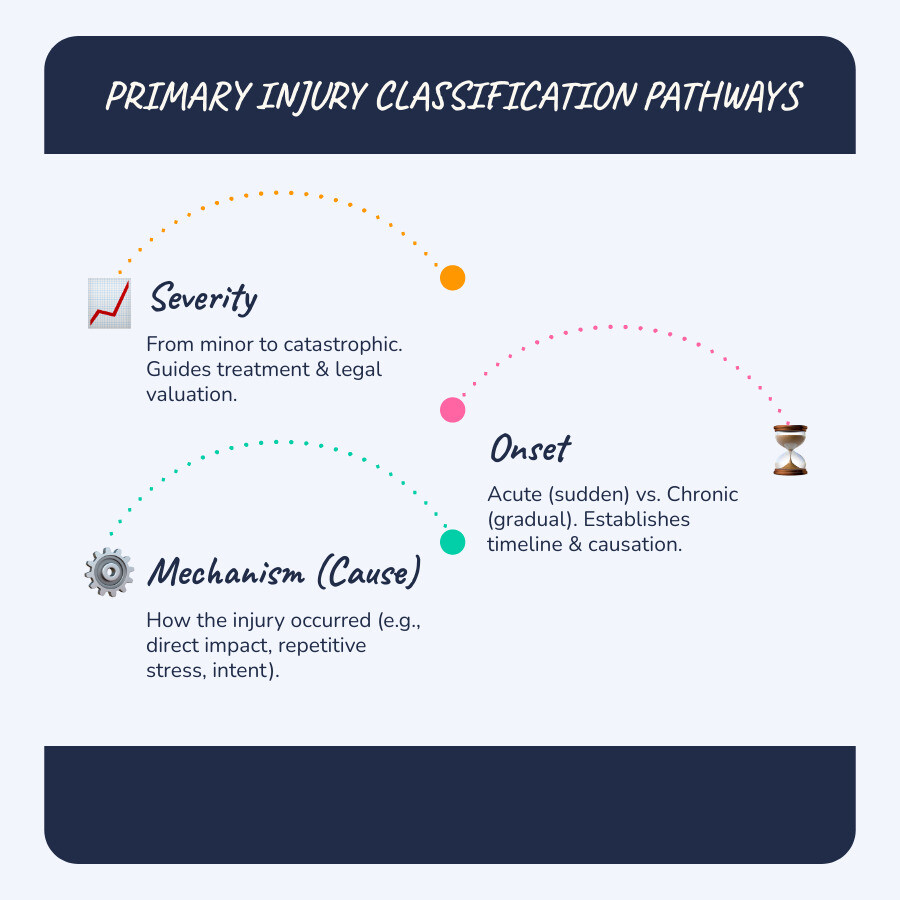
How are injuries classified? Injuries are classified using several standardized frameworks that examine severity (minor to catastrophic), onset (acute versus chronic), mechanism (how the injury occurred), body region affected, and tissue type damaged. Medical professionals use systems like the International Classification of Diseases (ICD-10-CM) and the Injury Severity Score (ISS), while legal experts rely on these classifications to establish causation, prove damages, and pursue accountability.
Primary Classification Methods:
| Classification Type | Key Categories | Purpose |
|---|---|---|
| Severity | Minor, Moderate, Serious, Catastrophic | Determines prognosis and compensation value |
| Onset | Acute (sudden), Chronic (gradual), Acute-on-chronic | Establishes timeline and causation |
| Mechanism | Contact, Non-contact, Intentional, Unintentional | Identifies how the injury occurred |
| Body Region | Head/neck, Spine, Extremities, Trunk, Internal organs | Pinpoints location of harm |
| Tissue Type | Bone, Muscle, Ligament, Nerve, Skin | Specifies nature of damage |
When a Georgia resident suffers a spinal cord injury in a trucking collision or a traumatic brain injury from a defective product, the medical and legal systems must speak the same language. Classification provides that common ground.
The stakes extend far beyond medical terminology. A severe burn classified as third-degree across 15% of the body carries vastly different implications than a minor abrasion. A catastrophic spinal injury resulting in paralysis demands lifelong care and millions in damages. An acute injury from a single devastating event requires different proof than a chronic injury from years of corporate negligence.
These classifications determine treatment protocols. They guide insurance adjusters in calculating payouts. They shape jury verdicts in civil litigation. Most critically, they provide the structure necessary to hold negligent parties accountable when their actions destroy lives.
The human cost cannot be reduced to codes and categories alone. But when corporations hide behind complexity and insurance companies minimize harm, a thorough understanding of injury classification becomes a weapon for justice.
Classification by Severity: From Minor to Catastrophic
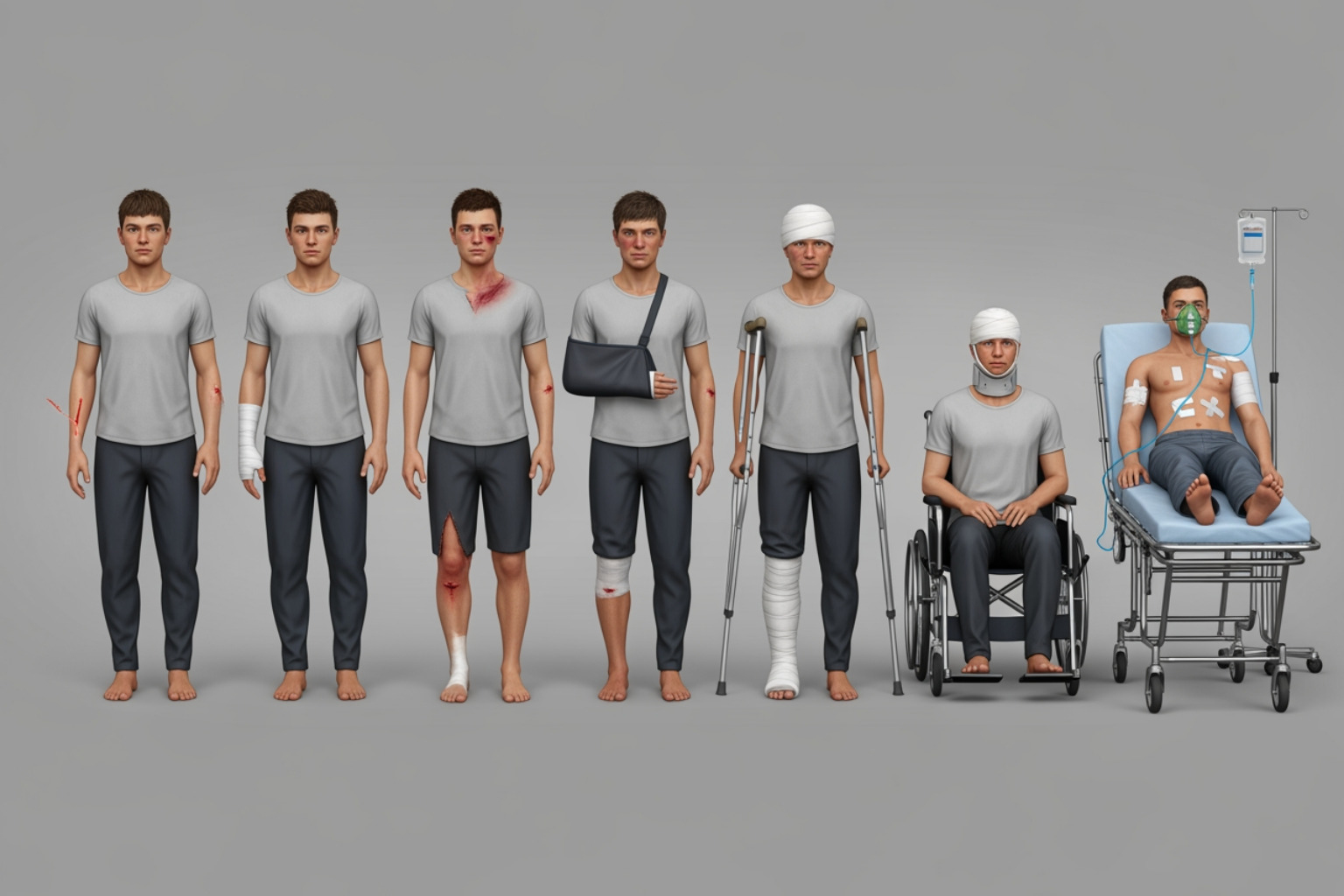
The severity of an injury stands as one of the most fundamental classifications. It dictates not only the immediate medical response but also the long-term prognosis, the extent of rehabilitation required, and the potential value of any legal claim. Injuries are commonly categorized into four levels of severity: minor, moderate, serious, and catastrophic. This framework provides a clear pathway for medical professionals to determine treatment and for legal experts to assess the profound impact on a victim’s life.
Minor and Moderate Injuries
Minor injuries represent the least severe end of the spectrum. They typically heal quickly with minimal medical intervention and do not result in long-term physical impairment. Common examples include bruises, small cuts, abrasions, mild sprains, minor strains, and mild whiplash. These injuries often respond well to conservative treatments such as the R.I.C.E. method (Rest, Ice, Compression, Elevation) and typically have a short recovery period. While painful, their impact on a person’s daily life is usually temporary.
Moderate injuries, while more significant than minor ones, still generally allow for a good prognosis with proper care. These injuries often require more extensive medical treatment, which may include medical procedures, physical therapy, or rehabilitation. They can lead to temporary disability or ongoing symptoms for a period. Examples often include simple bone fractures, dislocations, more significant sprains or strains (such as a ligament or tendon tear), and concussions. A concussion, for instance, is a temporary disruption of brain function that, while often resolving, requires careful monitoring and recovery protocols. Victims of moderate injuries may experience a disruption to their routine and require time away from work or daily activities.
Serious Injuries
Serious injuries mark a critical turning point, indicating damage that is debilitating and can lead to long-term impairment or significant life changes. While not always immediately life-threatening, these injuries often necessitate complex medical care, surgeries, and extended rehabilitation. The impact on a victim’s independence and quality of life can be profound and lasting.
Examples of serious injuries include severe Traumatic Brain Injuries (TBIs) that result in lasting cognitive, emotional, and physical impairments. Spinal cord damage, even if not leading to complete paralysis, can cause chronic pain, motor deficits, and sensory loss. Multiple complex fractures, especially those requiring surgical intervention and extensive reconstruction, can permanently alter mobility. Severe burns, beyond first-degree, can cause permanent scarring, nerve damage, and loss of function, requiring skin grafts and prolonged physical therapy. Internal organ damage, often sustained in high-impact collisions, can necessitate emergency surgery and result in chronic health issues. Understanding the full scope of such injuries is paramount when pursuing justice. To learn more about navigating these complex situations, explore What is Personal Injury Law?.
Catastrophic Injuries
Catastrophic injuries represent the most severe classification, permanently altering a person’s life and often resulting in lifelong disability or even death. These injuries require extensive, often lifelong, medical care, assistive devices, and personal support, leading to astronomical financial burdens and an immeasurable loss of quality of life.
Amputations, whether partial or complete, result in permanent loss of a limb or body part, necessitating prosthetics, extensive rehabilitation, and profound psychological adjustment. Severe spinal cord injuries often lead to paralysis, such as paraplegia (paralysis affecting the lower half of the body) or quadriplegia (paralysis affecting all four limbs and torso). These conditions result in lifelong dependency for basic functions and require constant medical management. Severe brain injuries can cause profound and permanent cognitive destruction, impacting memory, communication, personality, and the ability to live independently. Multiple organ failure, often a consequence of severe trauma, can lead to prolonged hospitalization, complex medical interventions, and a drastically reduced life expectancy.
When a catastrophic injury results in death, the legal system may recognize a Wrongful Death claim, seeking compensation for the profound losses suffered by the victim’s family, including funeral costs, loss of companionship, and future financial support. The fight for justice in such cases involves carefully documenting every aspect of the injury and its devastating aftermath.
How are Injuries Classified by Onset and Mechanism?

Beyond severity, the way an injury begins and the forces involved in its occurrence are crucial for classification. This aspect not only aids medical diagnosis but also forms the bedrock for establishing liability in legal claims. Understanding the injury’s timeline and the causal factors involved is essential for uncovering negligence and securing justice.
Acute vs. Chronic Injuries: The Element of Time
The timing of an injury’s onset provides a critical distinction:
- Acute Injuries: These injuries happen suddenly, often as a direct result of a single, identifiable traumatic event. They involve a rapid transfer of kinetic energy to the body, exceeding physiological tolerance. Examples include a broken bone from a fall, whiplash from a car accident, a ligament tear from twisting a joint, or a direct blow during a collision. The time between the incident and the appearance of the injury is short.
- Chronic Injuries (Overuse Injuries): In contrast, chronic injuries develop gradually over time, typically resulting from repetitive stress or overuse of a particular body area. They are often caused by low-load, long-duration activities that lead to cumulative tissue damage. Examples include tendinitis, stress fractures, or bursitis. These conditions often worsen progressively as the repetitive activity continues, and the body’s repair mechanisms cannot keep pace with the damage.
- Acute-on-Chronic Injuries: This category describes an acute exacerbation of a pre-existing chronic condition. For instance, an athlete with chronic tendinitis might experience a sudden, complete tendon rupture during an intense movement, classifying it as an acute injury occurring on a chronic condition.
How are injuries classified based on mechanism and intent?
The mechanism of injury refers to the forces or events that cause the injury, while intent addresses whether the injury was inflicted purposefully. These classifications are vital for medical treatment and for determining fault in legal proceedings.
- Mechanism of Injury:
- Direct Contact: Injuries resulting from direct physical impact, such as being struck by an object, involved in a collision, or sustaining a blow. Examples include blunt force trauma (e.g., from a car crash), penetrating trauma (e.g., a stab wound), or crush injuries.
- Non-Contact Events: Injuries occurring without direct external impact, often due to internal forces or sudden movements. Examples include a muscle strain from overstretching, a ligament tear from an awkward landing, or a fall that doesn’t involve striking an object.
- Environmental Factors: Injuries caused by exposure to elements like extreme temperatures (burns, frostbite), chemicals, electricity, or radiation.
- Insufficient Vital Elements: Injuries resulting from a lack of essential elements, such as strangulation (lack of air), drowning (lack of air/oxygen in water), or freezing (lack of warmth).
- Intent of Injury:
- Unintentional Injuries: Often referred to as “accidental,” these injuries occur without deliberate intent to harm. They are frequently the result of negligence, environmental hazards, or unforeseen circumstances. Motor vehicle collisions, falls, and unintentional poisonings are common examples. The majority of personal injury claims stem from unintentional acts caused by another party’s negligence.
- Intentional Injuries (Assault): These injuries are purposefully inflicted by another person with the intent to cause harm. Examples include physical assault, domestic violence, or criminal acts. While often falling under criminal law, victims of intentional acts may also pursue civil claims for damages.
- Self-Harm: Injuries inflicted by an individual upon themselves.
- Undetermined Intent: When the available evidence is insufficient to classify an injury as unintentional or intentional.
The International Classification of External Causes of Injuries (ICECI) and the International Classification of Diseases, Clinical Modification (ICD-CM) are recognized systems that categorize injuries by mechanism and intent, providing standardized data for public health and legal analysis.
Common Injury Mechanisms:
- Motor Vehicle Collisions (car, truck, motorcycle accidents)
- Falls (slips, trips, falls from heights)
- Struck By/Against Object
- Poisoning
- Burns (fire, chemical, electrical, thermal)
- Drowning/Suffocation
- Assault/Violence
- Overexertion
- Machinery Accidents
- Animal Bites
Specialized Classification Systems
In specific fields, more granular classification systems are used to provide highly detailed insights into injury patterns.
- Sports Injury Classification: Given the unique demands of athletic activity, sports medicine employs specialized systems. The International Olympic Committee (IOC) has established methods for recording and reporting epidemiological data on injury and illness in sports, standardizing surveillance for better prevention and treatment. Systems like the Munich Consensus Statement and the British Athletics Muscle Injury Classification (BAMIC) provide detailed grading for muscle injuries, often incorporating clinical findings and advanced imaging like MRI to assess severity, location, and potential for re-injury. These systems help physiotherapists and sports physicians tailor rehabilitation programs with greater precision. For further reading, see the International Olympic Committee methods for recording injury data.
The Anatomy of an Injury: Body Region and Tissue Type
A precise understanding of where an injury occurred and what specific tissues were damaged is fundamental to both medical diagnosis and legal documentation. This anatomical specificity allows medical professionals to target treatment effectively and enables legal experts to accurately pinpoint the harm suffered by a victim.
Classification by Affected Body Region
Injuries are systematically classified by the body region they affect, allowing for a clear and universally understood description of their location. The 2020 International Classification of Diseases, 10th Revision, Clinical Modification (ICD-10-CM) injury diagnosis framework provides a robust system for categorizing injuries by body region and nature of injury, facilitating consistent data collection and analysis.
Common body region categories include:
- Head and Neck: Encompassing the skull, brain, face, eyes, ears, nose, mouth, and cervical spine. Injuries here can range from concussions and facial fractures to severe traumatic brain injuries and spinal cord damage in the neck.
- Spine (Cervical, Thoracic, Lumbar): Injuries to the vertebral column and spinal cord, leading to potential paralysis or severe functional impairment.
- Upper Extremities: Including the shoulders, arms, elbows, forearms, wrists, and hands. Fractures, dislocations, sprains, and nerve damage are common.
- Lower Extremities: Encompassing the hips, thighs, knees, lower legs, ankles, and feet. These often sustain fractures, ligament tears (like ACL injuries), and sprains.
- Trunk and Torso: Involving the chest (thoracic cavity), abdomen, pelvis, and back. This region can suffer internal organ damage, rib fractures, and pelvic fractures.
- Internal Organs: Specific injuries to organs within the chest or abdominal cavities, often critical and life-threatening.
For detailed categorization of injuries by body region, the The 2020 ICD-10-CM injury diagnosis framework serves as a comprehensive guide used by medical and public health professionals.
How are injuries classified by the type of tissue damaged?
Beyond the general body region, classification often digs into the specific tissue type that has sustained damage. This level of detail is crucial for understanding the injury’s nature, guiding treatment, and assessing long-term impact.
- Bone Injuries (Fractures): A break in a bone. Fractures can be acute (sudden, from a single traumatic event) or stress fractures (from repetitive stress). They are further classified by type (e.g., open/closed, complete/incomplete, comminuted, spiral) and location.
- Muscle and Tendon Injuries (Strains, Tears): Muscles contract to produce movement, and tendons connect muscles to bones. Injuries can range from mild strains (overstretching) to partial or complete tears. These are often graded by severity (Grade 1, 2, or 3).
- Ligament Injuries (Sprains): Ligaments are tough bands of fibrous tissue that connect bones and stabilize joints. A sprain occurs when a ligament is stretched or torn, also typically graded by severity.
- Nerve Damage (Neuropathy): Injuries to nerves can result from trauma, compression, or stretching, leading to pain, numbness, tingling, weakness, or paralysis.
- Burns (Thermal, Chemical, Electrical): Damage to the skin and underlying tissues caused by heat, chemicals, electricity, or radiation. Burns are classified by degree (first, second, third, fourth) and the percentage of Total Body Surface Area (TBSA) affected, which dictates severity and prognosis.
The following table offers a comparison of common musculoskeletal injuries:
| Type of Injury | Tissue Affected | Common Causes | Characteristics |
|---|---|---|---|
| Sprain | Ligaments | Twist, fall, sudden impact forcing joint beyond normal range | Pain, swelling, bruising, limited joint mobility, instability (severe) |
| Strain | Muscles, Tendons | Overstretching, overexertion, repetitive movement | Pain, muscle spasms, weakness, swelling, bruising |
| Fracture | Bone | Direct blow, crushing force, fall, repetitive stress (stress fracture) | Severe pain, swelling, bruising, deformity, inability to bear weight/move limb |
The Role of Classification in Medical and Legal Arenas
Injury classification serves as a vital bridge between the medical and legal worlds. For medical professionals, it is the language of diagnosis and treatment. For legal experts, it forms the undeniable foundation for establishing causation, proving the full scope of damages, and ultimately, securing justice for victims of negligence. Without rigorous classification, the complexities of human suffering can be minimized, and accountability evaded.
Medical Classification: The Language of Diagnosis and Treatment
Medical professionals rely on standardized classification systems to accurately describe, diagnose, and treat injuries. These systems ensure consistency in medical records, facilitate communication among healthcare providers, and enable meaningful research into injury patterns and outcomes.
- International Classification of Diseases (ICD-10-CM): This is the primary coding system used in the United States for all diagnoses, including injuries. The ICD-10-CM provides highly specific codes for every imaginable injury, categorizing them by body part, nature of injury, external cause, and intent. This specificity is crucial for billing, health statistics, and epidemiological surveillance.
- Injury Severity Score (ISS): The ISS is a medical scoring system used to assess the overall severity of trauma in a patient. It is calculated by summing the squares of the highest Abbreviated Injury Scale (AIS) code in each of the three most severely injured body regions. The ISS ranges from 1 to 75, with higher scores indicating more severe injuries and a greater risk of mortality.
- Abbreviated Injury Scale (AIS): The AIS is an anatomically based, consensus-derived global severity scoring system that classifies individual injuries by body region according to their relative importance. AIS scores range from 1 (minor) to 6 (maximal, currently untreatable).
These systems guide treatment protocols, helping doctors make informed decisions about necessary interventions. They also play a critical role in predicting patient outcomes and determining the prognosis for recovery.
Legal Classification: The Foundation for Proving Damages
In the legal arena, injury classifications are indispensable. They provide the objective evidence required to translate physical harm into quantifiable damages, allowing victims to recover compensation for their losses.
- Establishing Causation: Precise injury classification helps legal teams connect the specific harm suffered by the victim directly to the negligent act of another party. For instance, a specific type of fracture, classified by its mechanism, can definitively link it to a particular type of collision.
- Quantifying Economic Damages: Medical records, replete with ICD codes and severity scores, form the basis for calculating economic damages. These include past and future medical bills, rehabilitation costs, lost wages, and loss of earning capacity. The more severe and complex the injury, the higher these costs can become. To understand how these calculations are performed, refer to How Compensation is Calculated.
- Calculating Non-Economic Damages: Injury classifications also underpin claims for non-economic damages, such as pain and suffering, emotional distress, loss of enjoyment of life, and disfigurement. The severity and long-term impact of a catastrophic injury directly correlate with the value assigned to these intangible losses.
- The Role of Expert Testimony: Medical experts, relying on these classification systems, provide crucial testimony to explain the nature, extent, and prognosis of a victim’s injuries to a jury. Their expert opinions, grounded in standardized classifications, are essential for conveying the full human cost of negligence. In complex cases, a skilled legal team, like Cheeley Law Group, understands how to leverage this medical evidence. A dedicated legal professional can guide you through the process, as outlined in The Role of a Car Accident Lawyer.
Holding Negligence Accountable
The truth behind an injury, carefully documented and expertly classified, is a powerful force in the pursuit of justice. When corporations prioritize profit over safety, when negligent drivers cause catastrophic collisions, or when defective products shatter lives, Cheeley Law Group stands ready to hold them accountable.
We understand that a severe traumatic brain injury or a spinal cord injury leading to paralysis is not merely a medical code. It is a life irrevocably altered, a family plunged into crisis, and a future stolen. Our “trial first” strategy means we relentlessly uncover the truth, exposing negligence through compelling evidence and unwavering dedication. We go toe-to-toe with the largest corporations, insurance companies, and institutions, fighting for record-setting verdicts and settlements for our clients.
If you or a loved one in Georgia has suffered a life-altering injury due to another’s negligence, understanding its classification is the first step toward securing justice. We invite you to Contact our firm to discuss your case. Let us bring our decades of experience and formidable courtroom presence to your fight. Our commitment to our clients in Alpharetta, Atlanta, Johns Creek, Roswell, Sandy Springs, Duluth, and Marietta is unwavering. Past results do not guarantee future outcomes. To learn more about our approach, visit our page on becoming a Georgia Personal Injury Lawyer.