
When a Life is Taken, Justice Must Be Delivered
When a loved one is lost due to another’s negligence or wrongful act, the grief is immeasurable. Georgia law provides a path for families to seek justice and financial stability through a wrongful death claim. This is not about assigning a price to a life, but about holding the responsible parties accountable and securing your family’s future.
Under Georgia Code § 51-4-2, a wrongful death claim allows specific family members to recover the “full value of the life of the decedent.” This includes both the tangible economic contributions the deceased would have made and the intangible loss of care, companionship, and counsel. It is a powerful legal tool designed to provide a measure of justice for an immeasurable loss.
Navigating this process is complex. It requires a deep understanding of the law and a relentless pursuit of the truth. At Cheeley Law Group, we stand with families during their most difficult times, fighting to ensure their voices are heard and justice is served.
Navigating a Georgia Wrongful Death Claim: The Legal Framework
When a life is tragically cut short by the actions of another, the legal system in Georgia provides a framework for families to seek redress. This framework is anchored in Georgia wrongful death law, a powerful tool designed to hold wrongdoers accountable and provide a measure of justice to those left behind. Understanding the foundational principles of this law is the first step toward securing that justice.
What Constitutes a Wrongful Death in Georgia?
A wrongful death in Georgia is not merely any death; it is a death directly caused by the “wrongful act” of another party. This is enshrined in Georgia Code 51-4-2, the state’s primary wrongful death statute. This “wrongful act” can manifest in several ways:
- Negligence: This is the most common basis for a wrongful death claim. It occurs when a person or entity fails to exercise reasonable care, and that failure leads to a fatality. Examples include fatal car accidents due to reckless driving, medical malpractice, or premises liability where dangerous conditions cause death.
- Criminal Act: If a death results from a crime—such as assault, homicide, or even a serious traffic violation—it falls under the purview of Georgia’s wrongful death statute. It is crucial to understand that a wrongful death lawsuit is a civil action, separate from any criminal prosecution. The burden of proof is lower in civil court, meaning a family can win a wrongful death claim even if the perpetrator is acquitted in a criminal trial.
- Defective Product: When a product is defectively designed, manufactured, or lacks proper warnings, and that defect causes death, a wrongful death claim can arise. This holds manufacturers and distributors accountable for putting dangerous goods into the market.
To prove a wrongful death claim in Georgia, the family must establish four key elements:
- Duty of Care: The defendant owed a legal duty to the deceased. For instance, drivers owe a duty to operate their vehicles safely.
- Breach of Duty: The defendant breached that duty through negligence or misconduct. This could be a driver running a red light or a doctor misdiagnosing a critical condition.
- Causation: The defendant’s breach of duty directly caused the death. The death must be a direct result of the wrongful act, not an unrelated factor.
- Damages: The death resulted in measurable losses to the surviving family.
At Cheeley Law Group, we relentlessly investigate these elements. We uncover the truth behind the tragedy, ensuring that every act of negligence or misconduct is brought to light. We understand that our clients, often grieving, seek answers and justice, not just compensation. For more details on these actions, refer to our insights on Georgia Wrongful Death Claims.
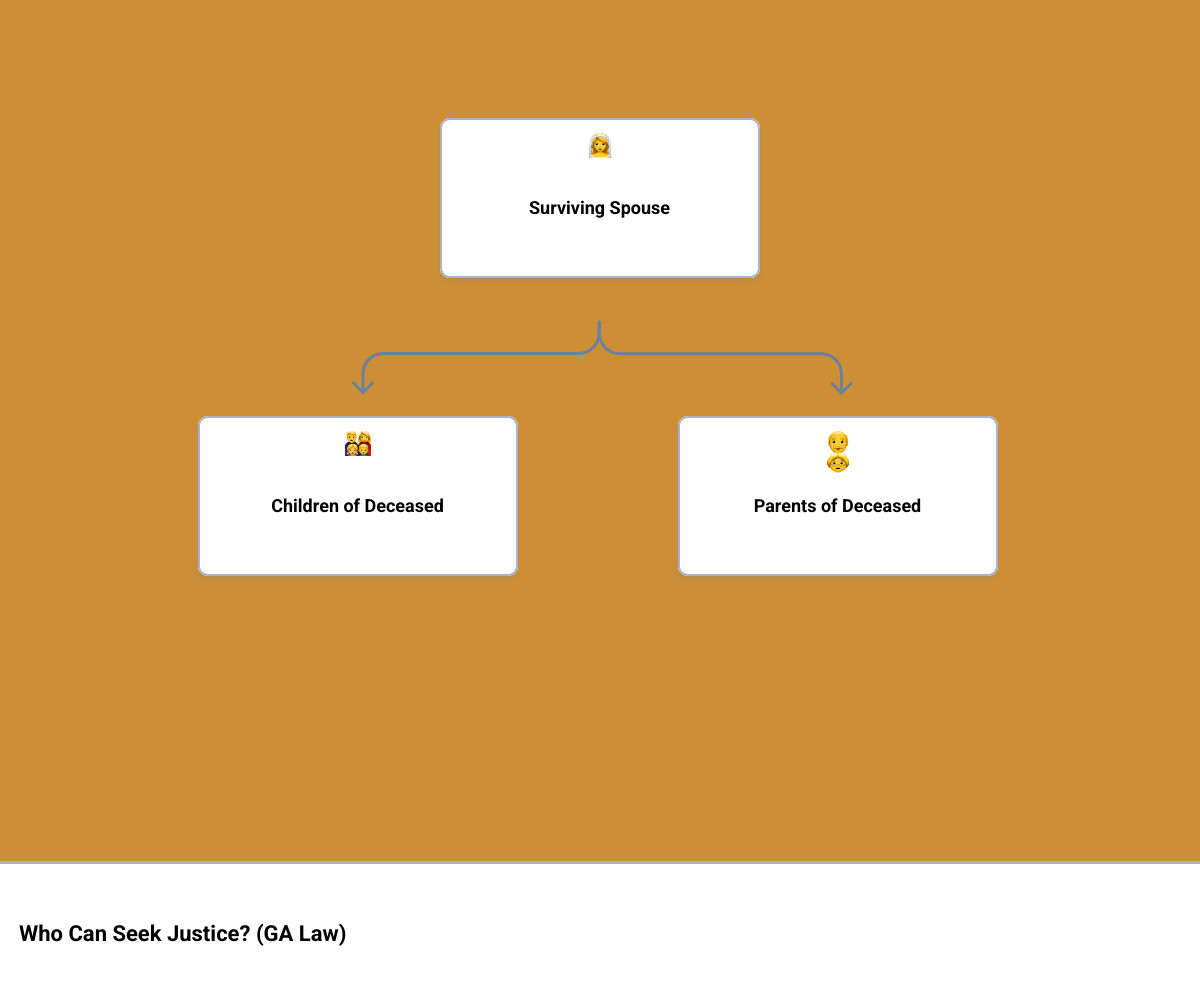
Who Can Seek Justice: The Hierarchy of Claimants
Georgia law establishes a strict hierarchy for who can file a wrongful death lawsuit. This ensures that the claim is brought by those most directly impacted by the loss. The legal standing to pursue a claim is critical, and navigating this can be complex for families already dealing with immense grief.
The order of eligibility is as follows:
- Surviving Spouse: If the deceased was married, the surviving spouse holds the sole right to bring the wrongful death claim. This right extends to representing any minor children. The law mandates that the surviving spouse must receive no less than one-third of any recovery, with the remainder shared with the children.
- Children: If there is no surviving spouse, the deceased’s children can bring the claim. This includes both minor and adult children. The recovery is divided equally among them per capita. Notably, the fact that a child was born out of wedlock does not affect their ability to recover damages in a wrongful death action. Descendants of any predeceased children would take per stirpes, meaning they would share the portion their parent would have received.
- Parents: If the deceased leaves no surviving spouse or children, the parents of the deceased can bring the claim. If both parents are living and married, they can file jointly. If they are separated or divorced, either parent can bring the claim, even if the other parent refuses to participate.
- Estate Representative: In the tragic event that the deceased has no surviving spouse, children, or parents, the administrator or executor of the deceased person’s estate can bring the wrongful death claim. This claim is then for the benefit of the deceased’s next of kin, as determined by Georgia’s laws of descent and distribution.
A critical aspect of Georgia law, as outlined in 2010 Georgia Code :: TITLE 51 – TORTS :: CHAPTER 4 – WRONGFUL DEATH :: § 51-4-2, allows a surviving spouse to release a wrongdoer without the concurrence of the children. However, the spouse must hold the consideration (settlement funds) subject to accountability and distribution rules, ensuring the children’s share is protected. This highlights the intricate nature of Georgia wrongful death law and the need for experienced legal counsel to safeguard the interests of all beneficiaries.
The Two Pillars of Recovery: Wrongful Death vs. Survival Actions
When a wrongful death occurs, Georgia law often provides for two distinct, though related, avenues of recovery: a wrongful death claim and a survival action. While both stem from the same tragic event, they address different types of losses and benefit different parties. Understanding this distinction is crucial for pursuing full accountability.

\| Feature | Wrongful Death Claim | Survival Action
Navigating a Georgia Wrongful Death Claim: The Legal Framework
When a life is tragically cut short by the actions of another, the legal system in Georgia provides a framework for families to seek redress. This framework is anchored in Georgia wrongful death law, a powerful tool designed to hold wrongdoers accountable and provide a measure of justice to those left behind. Understanding the foundational principles of this law is the first step toward securing that justice.
What Constitutes a Wrongful Death in Georgia?
A wrongful death in Georgia is not merely any death; it is a death directly caused by the “wrongful act” of another party. This is enshrined in Georgia Code 51-4-2, the state’s primary wrongful death statute. This “wrongful act” can manifest in several ways:
- Negligence: This is the most common basis for a wrongful death claim. It occurs when a person or entity fails to exercise reasonable care, and that failure leads to a fatality. Examples include fatal car accidents due to reckless driving, medical malpractice, or premises liability where dangerous conditions cause death.
- Criminal Act: If a death results from a crime—such as assault, homicide, or even a serious traffic violation—it falls under the purview of Georgia’s wrongful death statute. It is crucial to understand that a wrongful death lawsuit is a civil action, separate from any criminal prosecution. The burden of proof is lower in civil court, meaning a family can win a wrongful death claim even if the perpetrator is acquitted in a criminal trial.
- Defective Product: When a product is defectively designed, manufactured, or lacks proper warnings, and that defect causes death, a wrongful death claim can arise. This holds manufacturers and distributors accountable for putting dangerous goods into the market.
To prove a wrongful death claim in Georgia, the family must establish four key elements:
- Duty of Care: The defendant owed a legal duty to the deceased. For instance, drivers owe a duty to operate their vehicles safely.
- Breach of Duty: The defendant breached that duty through negligence or misconduct. This could be a driver running a red light or a doctor misdiagnosing a critical condition.
- Causation: The defendant’s breach of duty directly caused the death. The death must be a direct result of the wrongful act, not an unrelated factor.
- Damages: The death resulted in measurable losses to the surviving family.
At Cheeley Law Group, we relentlessly investigate these elements. We uncover the truth behind the tragedy, ensuring that every act of negligence or misconduct is brought to light. We understand that our clients, often grieving, seek answers and justice, not just compensation. For more details on these actions, refer to our insights on Georgia Wrongful Death Claims.
Who Can Seek Justice: The Hierarchy of Claimants
Georgia law establishes a strict hierarchy for who can file a wrongful death lawsuit. This ensures that the claim is brought by those most directly impacted by the loss. The legal standing to pursue a claim is critical, and navigating this can be complex for families already dealing with immense grief.
The order of eligibility is as follows:
- Surviving Spouse: If the deceased was married, the surviving spouse holds the sole right to bring the wrongful death claim. This right extends to representing any minor children. The law mandates that the surviving spouse must receive no less than one-third of any recovery, with the remainder shared with the children.
- Children: If there is no surviving spouse, the deceased’s children can bring the claim. This includes both minor and adult children. The recovery is divided equally among them per capita. Notably, the fact that a child was born out of wedlock does not affect their ability to recover damages in a wrongful death action. Descendants of any predeceased children would take per stirpes, meaning they would share the portion their parent would have received.
- Parents: If the deceased leaves no surviving spouse or children, the parents of the deceased can bring the claim. If both parents are living and married, they can file jointly. If they are separated or divorced, either parent can bring the claim, even if the other parent refuses to participate.
- Estate Representative: In the tragic event that the deceased has no surviving spouse, children, or parents, the administrator or executor of the deceased person’s estate can bring the wrongful death claim. This claim is then for the benefit of the deceased’s next of kin, as determined by Georgia’s laws of descent and distribution.
A critical aspect of Georgia law, as outlined in 2010 Georgia Code :: TITLE 51 – TORTS :: CHAPTER 4 – WRONGFUL DEATH :: § 51-4-2, allows a surviving spouse to release a wrongdoer without the concurrence of the children. However, the spouse must hold the consideration (settlement funds) subject to accountability and distribution rules, ensuring the children’s share is protected. This highlights the intricate nature of Georgia wrongful death law and the need for experienced legal counsel to safeguard the interests of all beneficiaries.
Furthermore, if a surviving spouse or child dies while a wrongful death action is pending, the action does not simply vanish. If the surviving spouse dies, the action survives to the child or children. If a child dies, it survives to the remaining surviving child or children. This provision ensures the pursuit of justice continues, despite further tragedy.
The Two Pillars of Recovery: Wrongful Death vs. Survival Actions
When a wrongful death occurs, Georgia law often provides for two distinct, though related, avenues of recovery: a wrongful death claim and a survival action. While both stem from the same tragic event, they address different types of losses and benefit different parties. Understanding this distinction is crucial for pursuing full accountability.
A wrongful death claim is brought by the family members (as per the hierarchy discussed above) for their losses. The compensation sought is for the “full value of the life” of the deceased, measured from the decedent’s perspective. This includes both economic and non-economic damages that the family has suffered due to the untimely death.
A survival action, on the other hand, is brought by the deceased’s estate. This action seeks to recover damages that the deceased person would have been entitled to claim had they survived their injuries. This typically includes:
- Pain and Suffering: The physical and emotional distress the deceased experienced from the time of injury until death. This can even include “pre-impact fright” or terror experienced in the moments leading up to a fatal event.
- Medical Expenses: All medical bills incurred for treatment of the fatal injuries before death.
- Funeral and Burial Expenses: The costs associated with the deceased’s funeral and burial.
It is important to note that recoveries from wrongful death actions are not subject to the decedent’s debts or liabilities. This means that creditors cannot claim a portion of the compensation awarded to the family for the loss of life. However, funds recovered through a survival action for the estate can be subject to the decedent’s estate debts, depending on the specifics of the estate.
Often, both a wrongful death claim and a survival action can be pursued simultaneously, allowing for comprehensive recovery. The Cheeley Law Group understands the nuances of these claims and relentlessly pursues every available avenue to ensure families receive the full measure of justice they deserve. For more insights into the broader context of legal actions, see our guide on Personal Injury Law.
| Feature | Wrongful Death Claim | Survival Action +