
Why Mediation Matters: A Strategic Tool in the Pursuit of Justice
Mediation offers a structured, confidential path to resolve disputes outside the courtroom, but its true value lies in strategy. It is a tool that allows our clients to preserve control, reduce the financial drain of litigation, and accelerate the timeline for justice. It empowers parties to dictate their own outcomes, maintain absolute privacy, and, in some cases, preserve critical relationships that a courtroom battle would destroy.
Key reasons mediation is important:
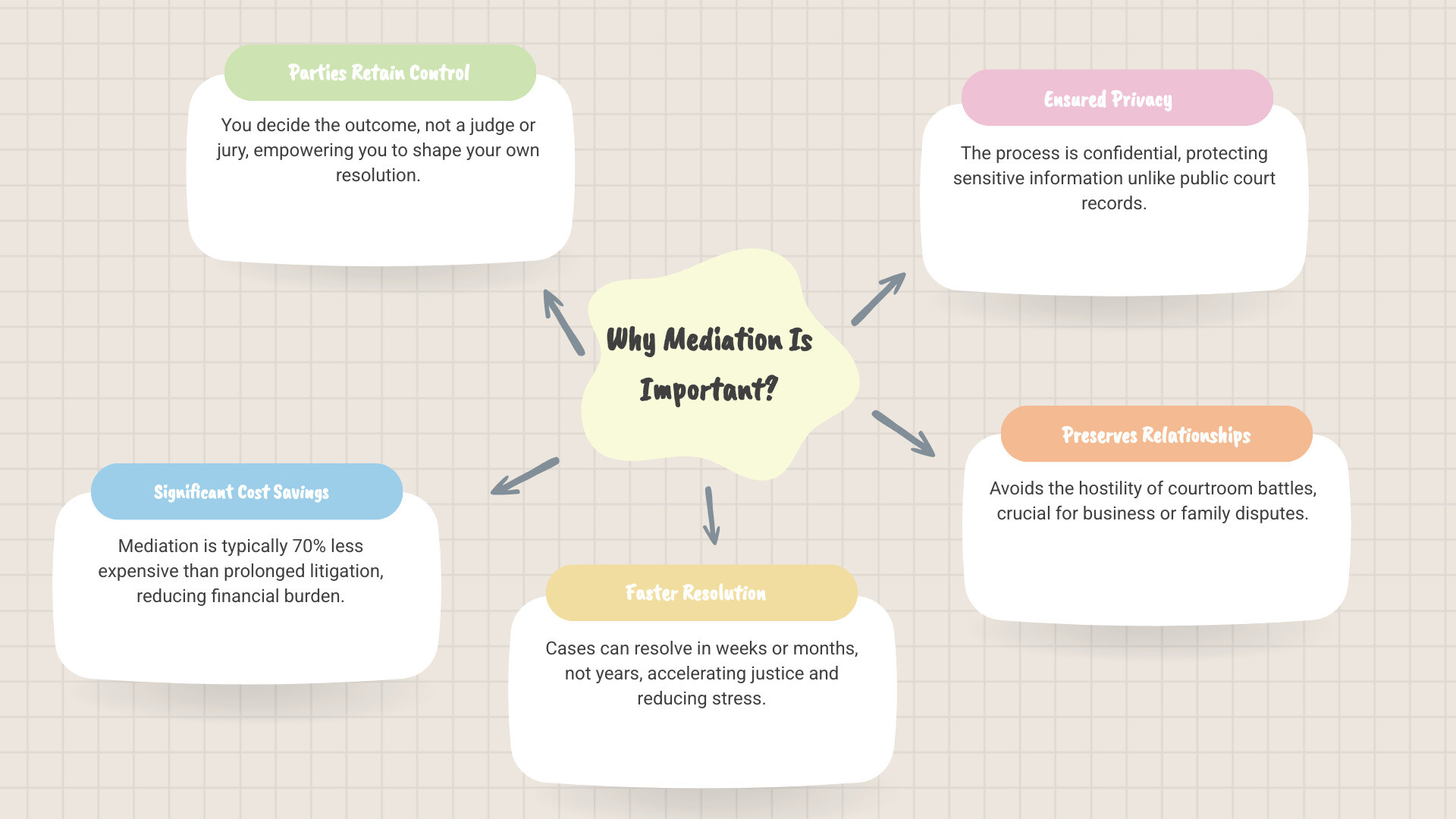
- Control – Parties decide the outcome, not a judge or jury
- Cost savings – Typically 70% less expensive than litigation
- Speed – Cases resolve in weeks or months, not years
- Privacy – Confidential process, unlike public court records
- High compliance – Parties honor agreements they helped create
- Relationship preservation – Avoids the hostility of courtroom battles
- Strategic insight – Reveals the other side’s case before trial
Mediation is not a retreat. It is a calculated move in high-stakes disputes.
When catastrophic injury, wrongful death, or corporate negligence upends your life, every decision carries weight. Mediation allows you to sit across from the party responsible and negotiate with strength, not desperation. A neutral mediator facilitates the conversation, but you retain authority over the result.
The process is voluntary. Confidential. And if the other side refuses to offer accountability, you walk away with valuable intelligence for trial.
Courts recognize mediation’s value. Studies show 70-80% of mediations end in agreement. Even when they don’t, the groundwork narrows issues and clarifies what matters most.
For families seeking justice after tragedy, mediation can provide answers and acknowledgment that a courtroom verdict cannot always deliver. For businesses targeted by dishonest partners, it offers a way to resolve disputes without airing proprietary details in public filings.
Mediation is not weakness. It is leverage.
Find more about Why mediation is important?:
What is Mediation?
Mediation is a form of alternative dispute resolution (ADR) that provides a strategic alternative to a public courtroom battle. It is a confidential and voluntary process where a neutral third party—the mediator—facilitates negotiation between the conflicting parties. Unlike a judge, a mediator has no power to impose a decision. Their purpose is to guide the conversation and help the parties engineer their own resolution.
This distinction is fundamental. In litigation, control is ceded to a judge or jury. In mediation, the power to approve or reject any agreement remains entirely with you. It is a structured negotiation designed to produce a binding settlement, but only if that settlement meets your terms.
The process is methodical. After selecting a mediator—often a retired judge or an attorney with deep expertise in the subject matter—each side presents its case. The mediator then engages in private caucuses with each party, probing for weaknesses, clarifying positions, and delivering candid “reality checks” about the risks of trial. The goal is to bridge the gap between the parties by focusing on core interests, not just rigid legal arguments.

The Core Advantages: Mediation vs. Litigation
Choosing between mediation and litigation is a strategic decision with profound consequences for your resources, timeline, and privacy. For the complex civil cases we handle for clients across Georgia, mediation consistently offers a more efficient and controlled path to accountability.
Cost Savings
Protracted litigation is designed to drain financial resources through years of motions, depositions, and trial preparation. Mediation disrupts this model, offering a resolution at a fraction of the cost—with some studies showing savings up to 70%. It eliminates the compounding expenses of expert witnesses, court reporters, and endless billable hours.
Time Efficiency
The legal system is notoriously slow, with cases often taking years to reach a courtroom. Mediation accelerates the timeline for justice, resolving disputes in a matter of weeks or even a single day. This speed allows victims and businesses to regain certainty and move forward, free from the weight of a pending lawsuit.
Unwavering Privacy
Court filings are public records, forcing sensitive personal, medical, or business information into the open. Mediation is completely confidential. All discussions are held “without prejudice,” meaning nothing revealed can be used against you if the case proceeds to trial. This shield of privacy creates a space for candid negotiation without fear of public exposure.
Preserving Relationships
The adversarial nature of a lawsuit is designed to destroy relationships. Mediation, by contrast, can preserve them. By focusing on a forward-looking solution instead of assigning blame, it helps parties find common ground. This is critical in disputes involving family members, business partners, or others where a continued relationship is necessary.
High Rates of Compliance
When parties build their own agreement, they are far more likely to honor it. Agreements reached in mediation have exceptionally high compliance rates because they are not imposed by a court; they are forged by the participants themselves. This sense of ownership ensures the resolution is durable.
| Factor | Mediation | Litigation |
|---|---|---|
| Cost | Lower | Higher |
| Time | Shorter | Longer |
| Privacy | Confidential | Public |
| Control | Parties decide | Judge/jury decide |
Empowerment and Control: Shaping Your Own Resolution
In a courtroom, you are a spectator to your own case. In mediation, you retain authority. This control is not just empowering; it is a strategic advantage for anyone demanding justice on their own terms.
You Dictate the Outcome
A judge or jury delivers a verdict that may satisfy no one. In mediation, no agreement is final until you approve it. You are the architect of the resolution, ensuring it addresses your specific needs and delivers the accountability you demand. This power of self-determination is the core of the mediation process.
Solutions a Court Cannot Order
Litigation is often limited to a single remedy: money. Mediation allows for customized solutions that a court has no power to impose. An agreement can include a formal apology, a change in corporate safety policy, or other non-monetary terms that provide a deeper sense of justice and can prevent future harm.
Uncovering the Truth
A skilled mediator can cut through legal posturing to expose the core issues driving a conflict. This facilitated dialogue forces both sides to confront the facts and risks of their positions. It serves as a powerful “reality check” that can lead to breakthroughs a formal legal process would never achieve.
A Foundation for Resolution
The mediator’s role is to ensure a constructive, fact-based negotiation, even when emotions are high. By improving the quality of communication, they help resolve the immediate dispute and can lay the groundwork for a more functional future relationship if necessary. The goal is to solve the problem without permanently severing ties.
Strategic Value: Mediation in Catastrophic Injury and High-Stakes Cases
For victims of catastrophic injury, wrongful death, or corporate negligence, the stakes are immeasurably high. Every decision made in the pursuit of justice must be strategic and purposeful. Here in Georgia, Cheeley Law Group understands that mediation is not a compromise of strength but a calculated maneuver in these complex, high-stakes cases. It is a powerful tool in a relentless fight for accountability.
When to Mediate
Mediation is effective across a broad spectrum of civil disputes. In our practice, we see its strategic utility in cases involving:
- Catastrophic Personal Injury: Where victims face life-altering injuries and overwhelming medical costs.
- Wrongful Death: Seeking justice and accountability for families devastated by loss.
- Product Defects: Challenging manufacturers whose negligence leads to harm.
- Trucking and Auto Tragedies: Holding negligent drivers and trucking companies responsible.
- Business Litigation: Resolving complex commercial disputes without public exposure.
Not a Sign of Weakness
Some may view an offer to mediate as a concession. We see it as a position of strength. Choosing mediation is an empowering move, demonstrating a willingness to seek resolution on your terms while retaining the ultimate authority to walk away if accountability is not met. It is a proactive step to control the narrative and the pathway to justice, rather than ceding it entirely to the unpredictable nature of a courtroom.
Gaining Strategic Insight
Mediation provides an invaluable opportunity to gain insight into the opposing side’s case. Even if a settlement is not reached, our attorneys can learn about the defense’s strategy, their perceived weaknesses, and the nuances of their arguments. This intelligence is critical for preparing a robust “trial first” strategy, arming us with knowledge that can prove decisive if the case ultimately proceeds to court. It is a chance to size up the opposition, understand their playbook, and refine our own.
Providing a Reality Check
In the private caucuses of a mediation session, the neutral mediator can deliver important “reality checks” to both parties. This objective assessment of legal positions, risks, and potential outcomes can be easier for a client to accept from an impartial third party than from their own attorney or the opposition. This candid evaluation helps to narrow issues, clarify priorities, and lay the groundwork for a more focused pursuit of justice, whether through settlement or trial.
Preparation for Trial
Even if mediation does not result in a full settlement, it is rarely a wasted effort. The process often clarifies the remaining points of contention, streamlining the issues that would need to be addressed in court. It allows for the exchange of information, the testing of arguments, and the identification of potential problems. This groundwork can significantly reduce the time and cost of subsequent litigation, ensuring that if a trial becomes necessary, our clients are exceptionally well-prepared to fight for the justice they deserve.
Navigating Your Path to Justice
In the wake of catastrophic injury or profound loss, the path to justice can seem daunting. Every decision, every strategic move, carries immense weight. At Cheeley Law Group, we understand that our clients seek more than just compensation; they seek accountability, truth, and the restoration of dignity. We stand as relentless champions, ready to steer the complexities of the legal system on their behalf.
Mediation, when wielded strategically, is a vital instrument in this pursuit. It offers a powerful avenue for resolution, allowing victims to engage directly with those responsible, to be heard, and to craft outcomes that truly reflect their needs. It is a testament to the power of structured negotiation, providing a platform to secure justice efficiently and effectively.
We arm our clients with the truth, the evidence, and the unwavering strategy required to hold wrongdoers accountable, whether at the mediation table or in the courtroom. We ensure our clients are empowered to make informed choices, always with their best interests at heart.
Explore our work in Personal Injury litigation.
Past results do not guarantee future outcomes. Cheeley Law Group, Alpharetta, Georgia.