
Why Choosing the Right Attorney Matters When Your Family Has Lost Everything
Lawyers for wrongful death suit must possess more than legal credentials. They need the investigative capacity to reconstruct a tragedy, the financial resources to challenge billion-dollar corporations, and a proven trial record that forces defendants to answer for their negligence. When selecting counsel, demand evidence of substantial verdicts, not just settlements, and verify their experience taking cases like yours to a jury.
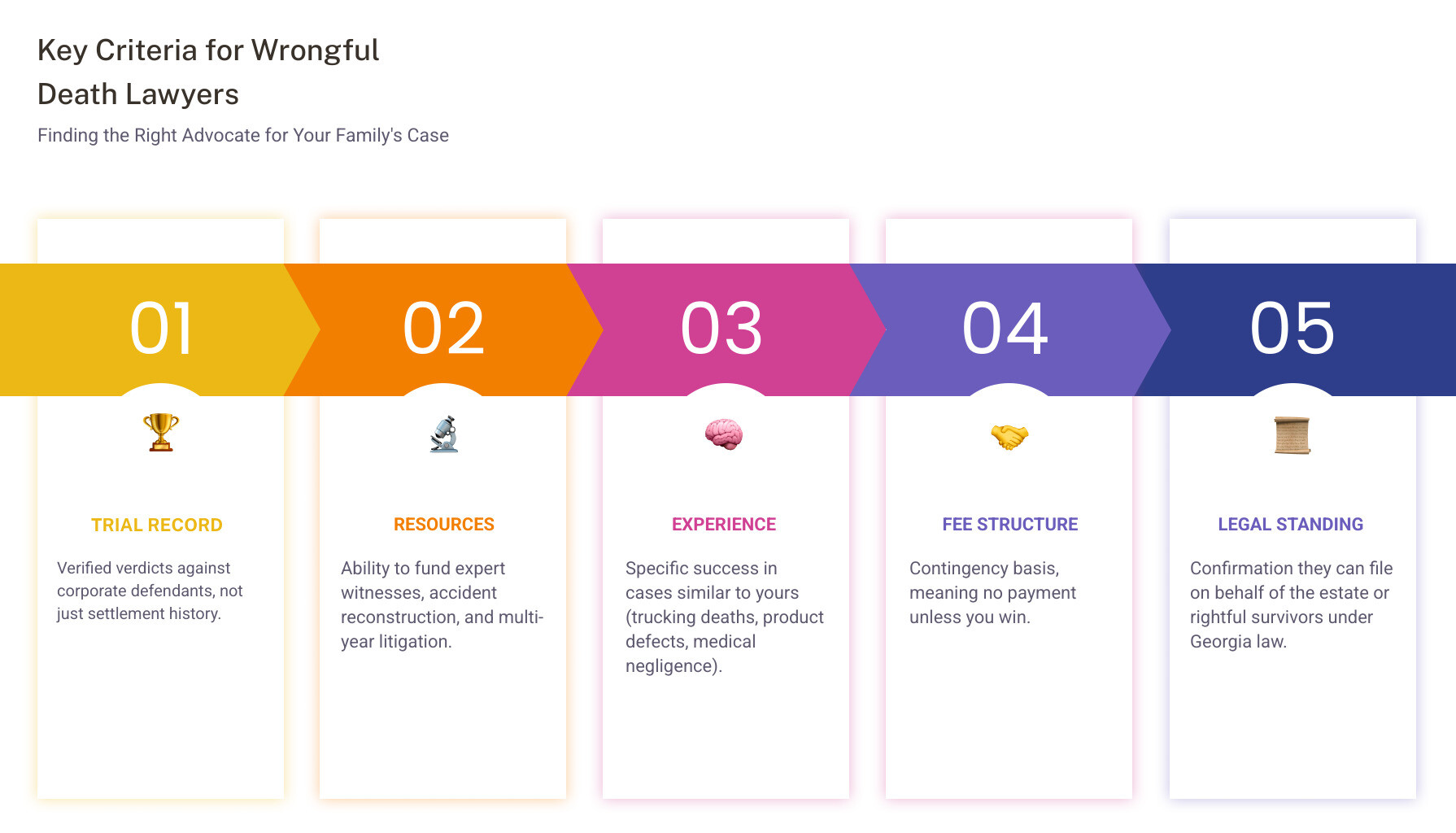
What to look for in wrongful death attorneys:
- Trial Record: Verified verdicts against corporate defendants, not just a history of settlements.
- Resources: The ability to fund expert witnesses, accident reconstruction, and multi-year litigation.
- Experience: Proven success in cases similar to yours (e.g., trucking deaths, product defects, medical negligence).
- Fee Structure: A contingency basis, meaning you pay nothing unless you win.
- Legal Standing: Authority to file on behalf of the estate or rightful survivors under Georgia law.
Losing a loved one to another’s negligence is devastating. The grief is compounded by the reality that without legal action, the responsible party may never face consequences. In Georgia, thousands die from accidental injuries each year, and many of those deaths result from wrongful acts—distracted drivers, defective products, or corporate cost-cutting that ignores safety.
A wrongful death claim is not about revenge. It is about accountability and the full value of a life lost.
Not every personal injury attorney is equipped for a wrongful death case. These claims demand a different level of commitment. They require an attorney who will spend years building a case, who can finance a battle against a manufacturer’s army of defense lawyers, and who has stood before a jury and secured eight-figure verdicts.
The difference between a settlement mill and a trial firm is this: one pressures you to take the first offer; the other builds a case so strong the defendant has no choice but to pay what the life was truly worth.
Georgia law gives surviving family members a narrow window to act—typically two years from the date of death. That clock is already ticking. The investigation must begin immediately, as evidence disappears, witnesses’ memories fade, and corporate defendants start building their defense.
This guide shows what separates a lawyer who talks about fighting for justice from one who has proven they can win it in court.
Understanding Wrongful Death: When a Loss Becomes a Legal Claim
A wrongful death occurs when a person is killed due to the legal fault of another person, company, or entity. This fault can stem from a negligent act, such as a distracted driver causing a fatal collision, or a reckless decision, like a manufacturer marketing a dangerously defective product. The core principle is that the deceased person would have had a valid Personal Injury claim had they survived their injuries. Understanding the scenarios that give rise to these claims is the first step toward seeking justice.

What Legally Constitutes a Wrongful Death?
In Georgia, a wrongful death claim arises when a person’s death is caused by the wrongful conduct of another. This conduct can include carelessness, negligence, intentional action, or criminal behavior. The law recognizes that when a life is cut short due to someone else’s fault, the survivors deserve a legal remedy.
To prove a wrongful death, four elements are required. First, the defendant owed a “duty of care” to the deceased, meaning a legal obligation to act in a way that prevents harm. Second, the defendant “breached” that duty through their failure to act safely. This could be a moment of distraction or a deliberate disregard for safety.
Third, this breach must have “caused” the death, establishing a direct link between the defendant’s actions and the fatality. Finally, the death must have resulted in “damages”—the economic and non-economic losses suffered by the surviving family members.
Wrongful death claims can stem from either negligent conduct or intentional misconduct. The law focuses on the defendant’s culpability and the resulting loss to the victim’s family, ensuring that those responsible for a preventable death are held accountable.
Common Scenarios Leading to Wrongful Death Claims
Wrongful death claims in Georgia arise from numerous preventable circumstances. These are not mere accidents; they are the direct result of negligence or intentional acts.
- Fatal Car Accidents: Distracted driving, speeding, and driving under the influence transform routine commutes into catastrophic events. These fatalities are often directly attributable to driver negligence.
- Commercial Trucking Collisions: The size and weight of commercial trucks mean minor errors can have devastating outcomes. When trucking companies prioritize profits over safety by neglecting vehicle maintenance or forcing drivers past their limits, the consequences can be fatal.
- Medical Malpractice: When healthcare professionals fail to meet the accepted standard of care—through misdiagnosis, surgical errors, or incorrect prescriptions—lives can be needlessly lost. These cases require attorneys with the expertise to challenge well-funded hospital legal teams.
- Defective Products: Manufacturers have a duty to ensure their products are safe. When a design flaw, manufacturing defect, or inadequate warning leads to a fatality, the responsible corporation must be held accountable.
- Unsafe Property Conditions (Premises Liability): Property owners must maintain a safe environment. Deaths resulting from unaddressed hazards, inadequate security, or structural failures can lead to wrongful death claims.
- Construction Site Negligence: While often involving workers’ compensation, wrongful death suits can arise from third-party negligence on a construction site. Safety violations or faulty equipment can create deadly environments that demand accountability.
The Anatomy of a Case: Proving Liability and Securing Justice
Winning a wrongful death lawsuit requires more than demonstrating a tragic loss; it demands a meticulous reconstruction of events to prove liability. Your legal team must establish that the defendant owed your loved one a duty of care, breached that duty, and that this breach directly caused the death and resulting damages. This process involves deep investigation, expert witnesses, and the ability to overcome complex legal defenses.

The Four Pillars: What Must Be Proven in Court
To secure justice in a wrongful death case, a plaintiff must prove four fundamental elements of negligence. First is the duty of care, establishing the defendant’s legal obligation to act reasonably to prevent harm. For instance, a driver has a duty to obey traffic laws.
Second is the breach of duty, meaning the defendant failed to uphold their legal obligation. This could be a negligent act, like speeding, or an omission, like failing to maintain safe property.
Third is direct causation. This pillar links the defendant’s breach of duty directly to the death. It must be shown that the death would not have occurred “but for” the defendant’s negligence, often requiring detailed accident reconstruction and expert testimony.
Finally, demonstrable damages must be proven. This element quantifies the losses suffered by the family, including economic losses like lost income and non-economic losses like the loss of companionship. The entire Personal Injury Court Process is geared towards establishing these pillars with compelling evidence.
The burden of proof in a civil case is “preponderance of the evidence,” meaning the plaintiff must show it is more likely than not that the defendant’s actions caused the death. This is a lower bar than the “beyond a reasonable doubt” standard in criminal cases but still demands a comprehensive presentation of facts.
Navigating Defenses: The Role of Comparative Negligence
Corporate defendants and their insurers rarely admit fault. A common defense is to shift blame onto the deceased, arguing the victim contributed to their own death. This is where Georgia’s “modified comparative fault” rule becomes critical.
Under this rule, if the deceased is found to be 50% or more at fault, their family is barred from recovering any damages. If the deceased is found to be less than 50% at fault, the damages awarded are simply reduced by their percentage of fault. For example, if a jury finds the deceased 20% responsible, the total damages are reduced by 20%.
This means a family may still be entitled to significant compensation even if their loved one partially contributed to the fatal incident. Experienced lawyers for wrongful death suit are relentless in countering these blame-shifting tactics, gathering evidence to prove the defendant’s primary culpability.
The Cheeley Law Group’s “trial first” strategy prepares to dismantle such defenses in court, ensuring that attempts to unfairly diminish a family’s rightful compensation are met with unwavering resolve. Understanding More on the legal theory of comparative negligence is crucial for any family seeking justice.
The Full Value of a Life: Damages in a Wrongful Death Action
In Georgia, a wrongful death claim seeks to recover the “full value of the life of the decedent,” a concept encompassing both tangible and intangible losses. This is distinct from a “survival action,” which the estate brings to recover for the deceased’s pre-death suffering and expenses. Calculating these damages requires sophisticated economic analysis and a compelling narrative to convey the profound personal loss.
Calculating Economic and Non-Economic Losses
In Georgia, the “full value of the life of the decedent” is a comprehensive measure of loss. Calculating this value is a complex process requiring seasoned lawyers for wrongful death suit and expert economists.
Economic losses are the quantifiable financial contributions the deceased would have made. This includes lost future income, lost benefits like health insurance and retirement, and the value of household services the deceased provided, such as childcare or home maintenance.
Non-economic losses represent the intangible but profound losses suffered by survivors. This includes the loss of care, companionship, society, advice, and parental guidance. Unlike in some states, Georgia’s “full value of life” standard allows for a holistic assessment of this impact.
Funeral and burial expenses are also recoverable as a direct consequence of the wrongful death. The meticulous process of calculating these damages is detailed in How Compensation is Calculated.
Expert economists are crucial for projecting future economic losses, considering factors like earning capacity, career trajectory, and life expectancy. This detailed financial analysis, combined with a compassionate articulation of non-economic losses, allows the Cheeley Law Group to present a compelling case for the true value of a life stolen by negligence.
Wrongful Death Claim vs. Survival Action: Understanding the Two Paths to Justice
In Georgia, families can pursue justice through two distinct legal avenues: a wrongful death claim and a survival action. While both hold negligent parties accountable, they compensate for different losses. Understanding this distinction is crucial for maximizing recovery.
A wrongful death claim is brought by surviving family members to compensate them for their losses. In Georgia, this means recovering the “full value of the life of the decedent,” including both economic contributions and non-economic losses like lost companionship and guidance.
A survival action is brought by the deceased’s estate to recover for harms the deceased experienced between the time of injury and death. This includes the deceased’s conscious pain and suffering, pre-death medical expenses, and lost wages during that period. The recovered funds become part of the estate.
The Cheeley Law Group understands how to strategically pursue both claims, where applicable, to ensure comprehensive justice for families.
| Feature | Wrongful Death Claim | Survival Action |
|---|---|---|
| Focus | Compensates surviving family members for their losses. | Compensates the deceased’s estate for losses incurred by the deceased before death. |
| Damages | “Full value of the life of the decedent” (economic: lost income, services; non-economic: lost companionship, guidance). | Deceased’s conscious pain and suffering, medical expenses, lost wages between injury and death. |
| Beneficiary | Surviving spouse, children, parents (as designated by Georgia law). | The deceased’s estate, distributed according to their will or Georgia’s laws of intestacy. |
| Purpose | To provide financial relief and acknowledge the loss suffered by the family. | To recover for the personal injuries and suffering the deceased endured before succumbing to their injuries. |
| Georgia Law | Governed by O.C.G.A. §51-4-2. | Governed by O.C.G.A. §9-2-41, allowing personal injury actions to survive the death of the injured party. |
The Critical First Steps: Filing a Claim and Choosing Your Advocate
The moments following a wrongful death are overwhelming, but legal deadlines are unforgiving. In Georgia, the statute of limitations for most wrongful death claims is two years from the date of death. The law also specifies who has the right to file the claim. Selecting the right legal advocate during this critical window is the most important decision a family can make.
Who Can File a Lawsuit and When?
Georgia law specifies a clear hierarchy of who can file a wrongful death lawsuit. Primarily, the surviving spouse has the first right to file, acting on behalf of themselves and any surviving children. The spouse must share any recovery with the children, with the spouse receiving a minimum of one-third.
If there is no surviving spouse, the right passes to the surviving children. If there are no children, the parents of the deceased may bring the action. Finally, if none of these family members exist, the personal representative of the deceased’s estate can file on behalf of the next of kin.
The timing is as critical as who files. In Georgia, the statute of limitations is generally two years from the date of death. Missing this strict deadline almost always results in the permanent loss of the right to seek compensation. Immediate action is essential.
Survivors must take steps to preserve their legal rights. This includes documenting the claim, gathering evidence, and beginning the process of probating the estate. Most importantly, contacting experienced lawyers for wrongful death suit promptly is crucial to secure evidence and protect the family’s interests while the clock is ticking.
The Cost of Justice: How the Best Lawyers for a Wrongful Death Suit Are Paid
For families reeling from a wrongful death, legal fees can feel like an impossible burden. The Cheeley Law Group operates on a contingency fee basis, a model that aligns our success directly with your recovery.
Under this arrangement, you pay no upfront legal fees. Our firm advances all costs of litigation, which can run into hundreds of thousands of dollars in complex cases. Our fee is a percentage of the final settlement or verdict. If we do not win your case, you owe no attorney fees. This is further explained in our Contingency Fee Explained guide.
This structure removes the financial barrier to justice, allowing you to focus on healing while knowing your legal team is fully invested in the fight. It ensures we are as motivated as you are to achieve the maximum possible recovery.
What to Demand from Lawyers for a Wrongful Death Suit
When entrusting a firm with your family’s future, you must demand more than promises. You need a firm with a demonstrable record of taking on powerful opponents and winning.
First, demand a verifiable trial record. Many firms avoid the courtroom. The Cheeley Law Group prepares every case for trial, a “trial first” strategy that often compels defendants to offer fairer settlements. Look for attorneys who have secured substantial verdicts, not just quick settlements. Past results do not guarantee future outcomes.
Second, inquire about the firm’s financial resources. Wrongful death cases are expensive, requiring funding for expert witnesses, investigations, and findy. A firm without deep pockets cannot effectively challenge a well-funded defense. The Cheeley Law Group has the resources to go the distance.
Third, demand a clear litigation strategy. Your attorneys should articulate a decisive path forward, demonstrating their understanding of the complexities specific to your case.
Finally, seek a firm with a proven track record in cases similar to yours—be it trucking deaths, product defects, or medical negligence. This specialized experience is critical. Our firm’s commitment to these principles is detailed on our About Us page.
Frequently Asked Questions About Lawyers for a Wrongful Death Suit
How long does a wrongful death lawsuit typically take to resolve?
The timeline for a wrongful death case varies. Simple cases with clear liability might settle within a year or two, but complex litigation against a large corporation can take several years. The Cheeley Law Group’s “trial first” strategy prepares every case for a jury from day one. This proactive approach often pressures defendants to offer a fair settlement sooner to avoid a costly trial. The Lawsuit Settlement Process is designed to bring swift, just closure.
Can I sue a government entity for wrongful death?
Yes, but suing a government entity in Georgia is challenging. These claims are subject to strict sovereign immunity laws, which protect government bodies from lawsuits. Cases against the government involve special notice requirements and much shorter deadlines, sometimes only six or 12 months. Failure to follow these precise procedures can permanently bar your claim. It is essential to work with lawyers for wrongful death suit who have specific experience navigating these complexities.
What if the person responsible was found not guilty in a criminal trial?
A criminal acquittal does not prevent a civil wrongful death lawsuit. The criminal and civil legal systems operate independently and have different standards of proof.
In a criminal case, the prosecution must prove guilt “beyond a reasonable doubt,” an extremely high standard. In a civil wrongful death lawsuit, the plaintiff must only prove their case by a “preponderance of the evidence.” This means showing it is “more likely than not” (greater than 50%) that the defendant’s actions caused the death. A defendant can be found not guilty in criminal court but still be held liable for damages in a civil case.
Demanding Accountability, Honoring a Legacy
Choosing a lawyer for wrongful death suit is about entrusting a firm with your family’s story and your loved one’s legacy. The right advocate is a relentless investigator and a proven trial attorney with the resources and resolve to take on powerful opponents and win. Justice in these cases is measured by the truth uncovered and the accountability secured. By holding negligent parties responsible, you not only protect your family’s future but also honor the full value of the life that was lost. The legal team at Cheeley Law Group, led by founding partner Robert D. Cheeley, is built for these high-stakes battles.
If your family is facing the unimaginable loss of a loved one due to another’s negligence, we are here to help you understand your legal rights. Learn how our firm secures justice in Wrongful Death cases.