
The Question Every Catastrophic Injury Victim Asks
How much injury claim compensation you can recover depends on the full scope of harm—not a generic formula, but a detailed accounting of every tangible and intangible loss caused by another’s negligence.
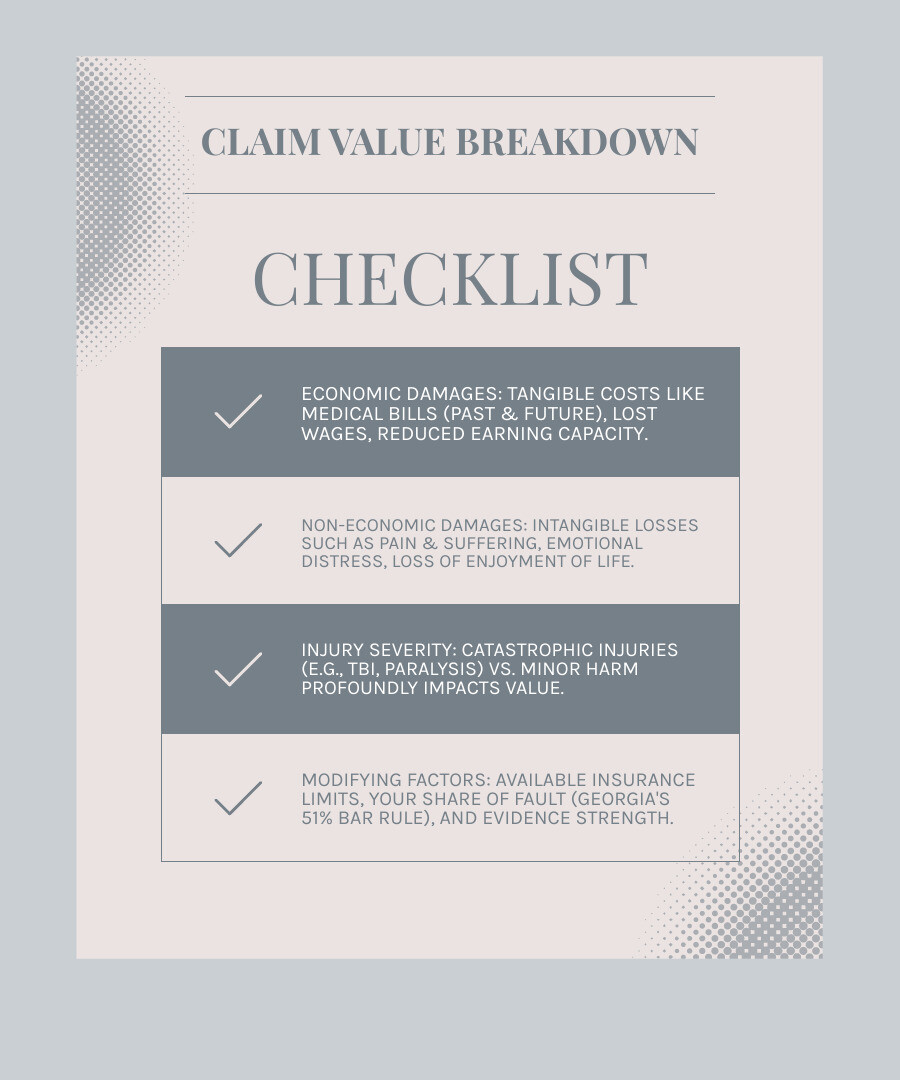
Quick Answer: Injury Claim Value Depends On:
- Economic Damages – Medical bills (past and future), lost wages, lost earning capacity, property damage, rehabilitation costs
- Non-Economic Damages – Pain and suffering, emotional distress, loss of enjoyment of life, permanent disability
- Severity of Injury – Catastrophic injuries like paralysis, TBI, or wrongful death command significantly higher values than soft tissue injuries
- Available Insurance Coverage – Claim value is limited by at-fault party’s policy limits and any umbrella or UM/UIM coverage
- Your Share of Fault – Georgia’s 51% bar rule reduces recovery proportionally if you bear partial responsibility
- Strength of Evidence – Documentation, expert testimony, and the credible threat of trial drive settlement value
The last thing you want after a catastrophic injury is uncertainty about what you’re owed. While no dollar amount can undo the harm—restore a lost limb, erase chronic pain, or bring back a loved one—the civil justice system provides a path to accountability.
While online sources cite a median personal injury settlement of $52,900, that figure is meaningless in isolation. It lumps minor whiplash claims together with multi-million dollar verdicts for paralysis and wrongful death. Similarly, averages for truck accidents ($103,654), medical malpractice ($679,000), and product liability ($748,000) fail to capture the true scope of catastrophic harm.
These numbers reveal a truth: injury claims are not one-size-fits-all. A case involving permanent disability and corporate negligence bears no resemblance to a fender bender with a few weeks of physical therapy.
This guide deconstructs how a claim’s value is determined, moving beyond simple calculators to explain what your case is truly worth. We will explain how damages are calculated, what factors drive negotiations, and why the right legal representation is the difference between a nuisance payout and full accountability.
Deconstructing the Value: Economic vs. Non-Economic Damages
A claim’s value is built on two distinct categories of losses. These damages represent the full extent of the harm inflicted by another’s negligence. Understanding both is the first step in demanding full accountability.
Quantifying the Tangible: Economic Damages
Economic damages, also known as special damages, are the tangible, calculable costs of an injury. These are the losses that come with a receipt or a clear numerical value, representing the direct financial impact on your life.
These include:
- Medical Bills: This includes all past, current, and reasonably certain future medical expenses, from emergency care and surgery to long-term therapy and rehabilitation.
- Lost Wages: If your injury forced you to miss work, you are entitled to compensation for all lost earnings, including salary, wages, and commissions.
- Future Earning Capacity: A catastrophic injury can permanently reduce your ability to earn a living. This loss of future earning capacity is a critical component of damages, representing the difference between your pre-injury and post-injury financial trajectory.
- Property Damage: In accidents involving vehicles or other property, the cost to repair or replace damaged items falls under economic damages.
- Rehabilitation Costs: This covers physical therapy, occupational therapy, vocational rehabilitation, and any other services designed to help you recover and adapt.
- Out-of-Pocket Expenses: Any other accident-related costs, such as transportation to medical appointments or home modifications for accessibility, are also recoverable.
Valuing the Intangible: Non-Economic Damages
Non-economic damages, or general damages, are the profound, human costs that don’t come with a set dollar amount. These subjective losses profoundly impact a victim’s quality of life and are often the most significant component of a catastrophic injury claim.
These vital components include:
- Pain and Suffering: This covers the physical agony and discomfort from the injury, both immediate and chronic, considering its intensity and duration.
- Emotional and Psychological Trauma: The psychological toll of an injury, including anxiety, depression, post-traumatic stress disorder (PTSD), fear, and grief, is a real and compensable harm that demands accountability.
- Loss of Consortium: When an injury damages a marital relationship, the uninjured spouse may have a claim for the loss of companionship, affection, and intimacy.
- Loss of Enjoyment of Life: This accounts for the inability to participate in hobbies, recreational activities, or daily routines that once brought joy and fulfillment. This loss carries significant value.
- Permanent Disfigurement: Scars, amputations, or other permanent changes to physical appearance can cause profound emotional suffering, meriting substantial compensation.
Key Factors That Drive a Claim’s Final Value
The value of a claim is not arbitrary. It is forged from the specific facts of the case, the severity of the harm, and the laws that govern recovery. These are the critical elements that determine the outcome and define how much injury claim compensation can truly be recovered.
The Severity and Permanence of the Injury

The nature and permanence of the injuries are the most significant drivers of a claim’s value. Catastrophic injuries that result in long-term disability, permanent impairment, or death command the highest values because they fundamentally alter a person’s life and require extensive, lifelong care.
Consider the following:
- Catastrophic Injuries: These are life-altering injuries that often lead to permanent disability or reduced life expectancy, requiring complex, ongoing medical care.
- Traumatic Brain Injury (TBI): A TBI can cause profound, lasting cognitive, emotional, and physical effects. Severe cases may require lifelong institutional care.
- Spinal Cord Injury: These injuries often cause partial or complete paralysis (paraplegia or quadriplegia), resulting in enormous costs for medical care, adaptive equipment, and lost earning capacity.
- Amputation: Losing a limb causes immense physical and psychological trauma, requiring prosthetics, rehabilitation, and significant life adaptation.
- Wrongful Death: When negligence causes a death, surviving family members can file a wrongful death claim to recover compensation for their economic and emotional losses.
- Long-Term Disability: Any injury causing a permanent inability to work or perform daily tasks has a high value due to its impact on earning potential and quality of life.
While soft tissue injuries are real and deserving of compensation, they typically result in lower payouts. The greater the harm and the longer its impact, the higher the accountability demanded.
The Role of Fault: Georgia’s Modified Comparative Negligence
Understanding how fault is assigned is critical in Georgia, as it directly impacts how much injury claim compensation you can receive. Georgia operates under a modified comparative negligence rule, the “51% Bar Rule.” This rule means if you are 50% or less at fault, you can recover damages, but your compensation will be reduced by your percentage of fault.
For instance, if your damages are $100,000 but you are found 20% at fault, your recovery is reduced to $80,000. If you are found 51% or more at fault, you are barred from recovering anything. This makes proving the other party’s fault a cornerstone of any successful claim.
Cheeley Law Group carefully investigates every aspect of an accident, utilizing accident reconstruction experts and compelling evidence to establish clear liability and minimize any claim of shared responsibility.
Insurance Policy Limits: The Practical Cap on Recovery
A claim is only worth what you can actually collect. In most cases, the at-fault party’s insurance policy limits create a practical cap on recovery, regardless of the full extent of your damages.
However, a tenacious legal team will not stop at the primary policy. They will relentlessly investigate all avenues for compensation, including:
- At-Fault Party’s Coverage: The primary insurance policy held by the negligent individual or entity.
- Commercial Policies: If the at-fault party was working, a much larger commercial policy may be available.
- Umbrella Policies: These provide additional layers of liability coverage and can significantly increase the available funds.
- Uninsured/Underinsured Motorist (UM/UIM) Coverage: Your own UM/UIM policy can cover your damages if the at-fault driver has insufficient insurance.
Insurance companies aim to pay as little as possible. It takes a dedicated legal team to uncover all available coverage and fight to ensure those policies pay what is justly owed.
How Is Pain and Suffering Calculated?
Insurance companies want you to believe there is a simple formula for pain—a multiplier applied to your medical bills. They might suggest multiplying your medical expenses by a factor of 1 to 5 to arrive at a value for your pain and suffering. This is a myth designed to devalue your claim. True valuation is not about a sterile calculation; it is about demonstrating the human cost of negligence to a jury, capturing the unique impact on your life, and demanding full accountability.
Beyond the Formula: A Jury’s Perspective

When a jury considers damages for pain and suffering, they are not looking at a spreadsheet. They are looking at the human being whose life has been irrevocably altered. They weigh the evidence presented, listen to compelling testimony, and consider the profound impact the injury has had.
Factors that truly influence a jury’s perspective include:
- Impact on Daily Life: The injury’s effect on your ability to perform daily tasks, care for yourself, and participate in family life.
- Loss of Independence: Whether the injury has forced you to rely on others, eroding your autonomy.
- Chronic Pain: The presence of ongoing, debilitating pain that is likely to be permanent.
- Psychological Impact: The full emotional and mental toll, including anxiety, depression, and PTSD.
- Testimony from Family and Friends: Powerful testimony from loved ones describing how the injury has changed you.
- Expert Witness Reports: Objective evidence from medical, psychological, and vocational experts on the injury’s severity and long-term consequences.
Noneconomic suffering like PTSD can be particularly challenging for courts to assign a monetary value, but it is no less real. A trial-first firm excels at translating these intangible losses into a compelling narrative that resonates with a jury, ensuring the full human cost is recognized.
How much injury claim can I expect based on documentation?
To effectively demonstrate the true extent of your pain and suffering, meticulous documentation is paramount. Every piece of evidence helps build a comprehensive picture of your ordeal and strengthens your claim for full compensation.
Key documentation includes:
- Medical Records: These are the backbone of any claim, detailing diagnoses, treatments, and prognoses.
- Personal Journals: A personal journal provides a powerful, account of your daily pain, emotional state, and physical limitations.
- Photographic Evidence: Images of your injuries as they heal (or fail to heal) can visually convey the physical trauma.
- Video Evidence: Videos showing your struggle with tasks you once performed easily can powerfully demonstrate your loss of enjoyment and physical limitations.
- Before-and-After Testimony: Testimony from friends, family, and colleagues contrasting your life before and after the accident can paint a vivid picture for a jury.
Documenting pain and suffering is not about exaggeration; it’s about providing undeniable evidence of the reality you now face. This comprehensive approach is essential for securing maximum compensation.
How Much Injury Claim Can I Expect for Different Cases?
Online statistics and “average” settlement amounts are dangerously misleading. They offer a false sense of what your specific case might be worth. The median payout for a car accident involving minor injuries has no bearing on a case involving a permanent spinal cord injury from a defective product. The value is tied to the specific facts, the severity of the harm, and the unwavering pursuit of accountability.
Understanding Averages for Car and Truck Accidents
Online research reveals a wide range of figures, with a reported average personal injury settlement around $55,000 and a median of $52,900. This distinction is crucial, as a few multi-million dollar cases can drastically skew the “average,” making it an unreliable predictor for your own case.
Consider these statistics:
- The median award for motor vehicle crashes is $16,000.
- The average auto accident settlement is $37,248.
- The average truck accident settlement is $103,654.
These figures are skewed by the high volume of minor injury cases, which settle for far less and dilute the averages. They bear no resemblance to cases involving catastrophic harm.
At Cheeley Law Group, we understand that your case is not an average. Whether it’s a car accident or a catastrophic truck accident, our focus is on the unique, devastating impact on your life, not on generic statistics. We specialize in personal injury cases where the stakes are life-changing.
How much injury claim for catastrophic harm?
When it comes to catastrophic harm, the concept of an “average” settlement becomes even more irrelevant. These cases involve profound and permanent injuries, often against powerful corporations, and demand a legal team with the resources and resolve for a relentless fight.
Consider the median awards for specific types of catastrophic cases:
- Medical Malpractice: The median award for medical malpractice cases is $679,000.
- Product Liability: When a defective product causes severe injury, the median award is $748,000.
- Premises Liability: For injuries on someone else’s property, the median award is $90,000, though this can be significantly higher for severe injuries.
- Wrongful Death: These are the most tragic cases. Verdicts can reach into the tens of millions, as seen in cases where families received $72 million or $37.5 million for wrongful death.
These high-value verdicts and settlements are what truly define accountability when catastrophic harm occurs. They reflect the immense economic and non-economic damages associated with such injuries.
Past results do not guarantee future outcomes.
The Settlement Process: From Demand to Resolution
The timeline of a personal injury case is a strategic consideration. While about 95% of cases settle out of court, the quality of that settlement is determined by a firm’s willingness and ability to go to trial. Insurance companies often offer low initial settlements, knowing that many victims are desperate for quick resolution. It takes a tenacious approach to secure the full and fair compensation you deserve.
The Timeline: Why Patience Is a Weapon
Resolving a claim takes time, and patience is a strategic asset. The average claim takes nearly a year to resolve, and complex catastrophic injury cases take much longer. Rushing the process often means accepting less than you are owed.
The process typically involves:
- Initial Investigation: Gathering all evidence, including medical records, police reports, witness statements, and accident reconstruction data.
- Demand Letter: Once you reach maximum medical improvement (MMI), a comprehensive demand letter is sent to the insurer, detailing your damages and the legal basis for your claim.
- Negotiation Phase: The battle begins here. Insurers will make a low initial offer to minimize their payout. The first offer is never the final offer and rarely reflects the claim’s true value.
- Insurance Adjuster Tactics: Insurers are notorious for trying to devalue claims, delay the process, or even blame the victim. An experienced attorney knows these tactics and fights back aggressively.
For a deeper dive into this process, explore the Lawsuit Settlement Process.
The Power of a Trial-Ready Strategy
While most cases settle, the threat of trial is the most powerful leverage a victim has. This is where Cheeley Law Group’s “trial first” strategy comes into play. We prepare every case as if it will go before a jury, demonstrating to insurance companies that we are ready to fight for full accountability. This approach often forces them to offer fair settlements to avoid the risks of litigation.
The litigation process includes:
- Filing the Lawsuit: Initiating legal proceedings by formally filing a complaint with the court.
- Findy Process: Both sides formally exchange information through documents, written questions (interrogatories), and requests for admissions.
- Depositions: Key witnesses, including parties, doctors, and other experts, provide sworn testimony outside of court.
- Expert Witnesses: Experts in medicine, accident reconstruction, and economics are crucial in catastrophic cases to prove liability and the full extent of damages.
- Mediation: A neutral third party helps facilitate a settlement in a non-binding process.
- Preparing for Court: If a settlement isn’t reached, the case moves to trial, where a jury will ultimately decide the outcome.
For more information, see our guide on the Personal Injury Court Process.
What Happens After a Settlement Is Agreed Upon?
After a settlement is reached or a verdict is won, several steps must be completed before you receive your funds.
- Settlement Agreement: A formal document is signed by all parties, outlining the terms and releasing the at-fault party from future liability.
- Paying Liens: Outstanding medical liens and health insurance subrogation claims are paid from the settlement funds.
- Attorney Fees: Your attorney’s contingency fees are deducted at this stage.
- Disbursement of Funds: Once all liens and fees are paid, the net compensation is disbursed to you, a process that typically takes 30-60 days to complete.
Frequently Asked Questions about Injury Claim Valuation
Are personal injury settlements taxable in Georgia?
In Georgia, compensation for physical injuries—including medical bills, lost wages, and pain and suffering—is generally not taxable by the IRS or the state. However, punitive damages and any interest earned on the settlement are typically considered taxable income. Always consult a tax professional to understand the implications for your specific situation.
How can an attorney maximize my settlement?
An experienced trial attorney maximizes your claim’s value in ways that go far beyond simple negotiation. They do this by:
- Thorough Investigation: Uncovering every piece of evidence to identify all liable parties and expose corporate negligence.
- Retaining Top Experts: Using leading medical, accident reconstruction, and economic experts to build an undeniable case for damages.
- Calculating Future Damages: Calculating the full lifetime cost of an injury, including future medical care and lost earning capacity, to ensure nothing is left on the table.
- Demonstrating a Credible Threat of Trial: Leveraging a credible threat of trial. Insurers know which firms are willing to fight in court and pay more to avoid a battle with a proven trial firm.
Attorneys who work on a contingency fee basis only get paid if they win, aligning their interests with yours to maximize your recovery.
What is the statute of limitations for filing an injury claim in Georgia?
In Georgia, the statute of limitations for most personal injury claims is two years from the date of the injury, according to the Official Code of Georgia Annotated (OCGA) §9-3-33. This is a strict deadline to file a lawsuit.
While some exceptions exist for minors or claims against government entities, missing this deadline will permanently bar you from recovering compensation. It is critical to consult an attorney immediately to protect your rights.
Conclusion
Determining the full value of an injury claim requires more than a calculator—it demands a relentless pursuit of the truth and a deep understanding of what was taken from you. It is about holding negligent parties accountable for the total scope of the damage they caused, from immediate medical bills to a lifetime of pain and lost potential.
At Cheeley Law Group, we uncover the full story to ensure the compensation reflects the true cost of the harm. We go toe-to-toe with powerful corporations and insurance giants, leveraging our “trial first” strategy to secure the justice our clients deserve. If you or a loved one has suffered a catastrophic injury, your fight is our fight.
Past results do not guarantee future outcomes.
Schedule your consultation to understand the true value of your claim.