
When Negligence Takes a Life: The Path to Justice in Georgia
Georgia wrongful death claims provide a legal avenue for families to hold negligent parties accountable when a loved one’s death results from another’s wrongful act. Under Georgia law, these claims serve two distinct purposes: the Wrongful Death Claim seeks the full value of the deceased person’s life (brought by surviving family members), while the Estate Claim recovers the decedent’s pain, suffering, and expenses before death (brought by the estate representative).
Key Facts About Georgia Wrongful Death Claims:
- Who Can File: Surviving spouse first, then children, then parents, then estate representative
- Time Limit: Generally two years from date of death (with specific exceptions)
- Recoverable Damages: Economic losses (wages, benefits) and intangible losses (companionship, counsel, relationships)
- Estate Recovery: Medical bills, funeral costs, and the deceased’s pre-death pain and suffering
- Minimum Spouse Share: Surviving spouse receives at least one-third of recovery, regardless of number of children
The sudden loss of a loved one is a profound, life-altering event. When that loss is caused by another’s negligence, the search for answers and accountability begins.
A wrongful death claim is not about assigning a monetary value to a person. It is about securing justice for the life that was taken and providing for the family left behind.
The civil justice system in Georgia recognizes that when someone dies due to reckless, negligent, or intentional conduct, those responsible must be held accountable. These cases force the truth into the light—exposing corporate negligence, unsafe practices, and the failure to protect human life.
Cheeley Law Group, based in Georgia, has helped families secure over $1.3 billion in verdicts and settlements by uncovering the truth and forcing wrongdoers to answer for the harm they caused. Past results do not guarantee future outcomes.
This guide explains the legal framework for Georgia wrongful death claims and how a focused, trial-ready firm can pursue accountability when the stakes are life-changing.
What Constitutes a Wrongful Death in Georgia?
In Georgia, a wrongful death occurs when an individual’s death is caused by the “reckless, criminal, negligent, or intentional act of another entity (i.e., a business) or person.” This definition establishes the legal basis for action. It means the death was not a random accident, but a direct consequence of someone else’s choices, misconduct, or failure to uphold a reasonable standard of care.
Negligence is a cornerstone of many wrongful death claims. It means a party failed to use reasonable care when they had a duty to do so, and that failure resulted in fatal harm. A distracted truck driver drifting across the center line, a property owner ignoring a known hazard that causes a deadly fall, or a hospital system allowing preventable medical errors are all patterns of negligence that take lives.
Reckless conduct goes beyond simple negligence and involves a conscious disregard for the safety of others. This could include driving at excessive speeds in dangerous conditions or operating heavy machinery without proper training. Intentional acts, such as assault or homicide, clearly fall under the definition of wrongful death, as they involve a deliberate intent to cause harm. Deaths resulting from criminal acts, whether intentional or not, also provide grounds for a wrongful death claim. Georgia law is clear on this: the state defines wrongful death as a death caused by such acts.
Proving Liability
Proving liability in a wrongful death claim requires establishing four key elements, similar to a Personal Injury case. First, there must be a duty of care, meaning the responsible party had a legal obligation to act in a certain way to prevent harm. Drivers must operate their vehicles safely. Trucking companies must follow safety rules. Hospitals must provide competent medical care.
Second, a breach of duty must have occurred. This means the responsible party failed to meet that duty of care. A driver texting behind the wheel breaches their duty of care, as does a manufacturer selling a dangerously defective product. Third, causation must be established—a direct link between the breach of duty and the death. The evidence must show that the negligent or wrongful act led to the fatal outcome.
Finally, damages must have resulted from the death. These are the losses suffered by the surviving family members due to the wrongful act. Establishing these elements is crucial for demonstrating legal fault and securing justice for the deceased and their family.
At Cheeley Law Group, we build these elements through exhaustive investigation—vehicle data, corporate policies, internal emails, witness testimony, and expert analysis—so that negligence cannot stay hidden. Past results do not guarantee future outcomes.
Who Has the Right to File a Claim?
Georgia law is precise about who is allowed to bring a wrongful death claim. This hierarchy ensures that the individuals most directly impacted by the loss have the primary right to seek justice and accountability.
The first person permitted to file a claim is the surviving spouse of the deceased. If the deceased person and the spouse have minor children, the spouse is legally required to represent the interests of those children in the claim. Georgia law guarantees the spouse at least one-third of the total recovery, regardless of the number of children involved. This provision ensures the surviving spouse receives a foundational level of support.
If there is no surviving spouse, the right to file passes to the surviving adult children of the deceased. These individuals, known as sui juris under the law, can collectively bring the claim. If there are no surviving children, the claim then falls to the surviving parents of the deceased.
Only if there is no surviving spouse, no surviving children, and no surviving parents can the administrator or executor of the deceased’s estate bring the claim. In such cases, the administrator acts on behalf of the deceased’s next of kin, as determined by Georgia’s laws of descent and distribution. This strict hierarchy, outlined in OCGA § 51-4-2, is designed to prevent multiple claims and clarify who holds the legal standing to pursue justice.

The Critical Distinction: Wrongful Death vs. Estate Claims
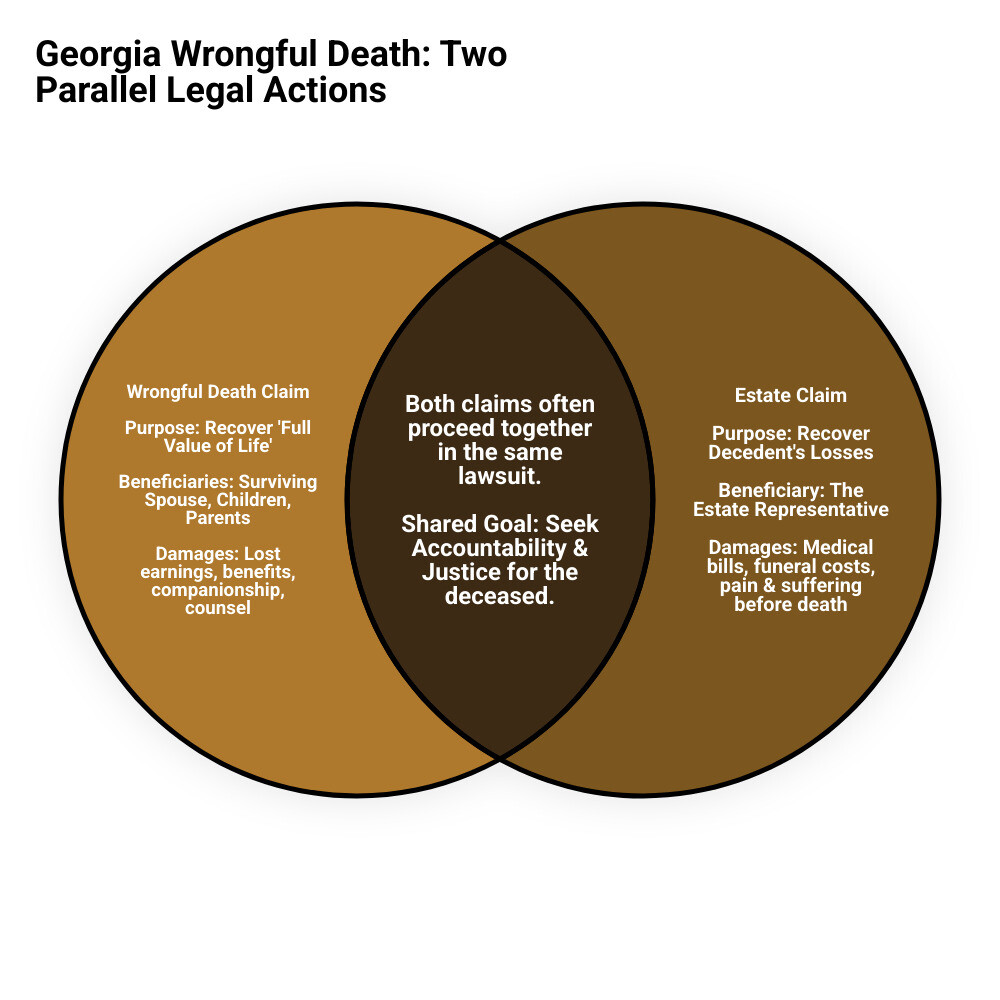
In Georgia, it is crucial to understand that there are two distinct types of claims that can arise from a wrongful death, often pursued simultaneously in the same lawsuit. These are the Wrongful Death Claim and the Estate Claim. While both seek compensation stemming from the death, their purposes, beneficiaries, and recoverable damages differ significantly.
The Wrongful Death Claim belongs to the surviving family and focuses on the full value of the life of the person who was killed—both the economic value (earnings, benefits, services) and the intangible value (the loss of companionship, guidance, and relationships). The Estate Claim belongs to the decedent’s estate and addresses the harm suffered by the person before death—medical bills, funeral expenses, conscious pain and suffering, and, in some cases, punitive damages to punish and deter egregious misconduct.
Cheeley Law Group evaluates and pursues both paths where the law allows, so that the story of the life lost and the suffering endured is fully presented and every legally available avenue of accountability is explored. Past results do not guarantee future outcomes.
Schedule Your Consultation to discuss which claims may apply in your family’s case and how Georgia’s wrongful death laws operate in practice.
When Negligence Takes a Life: The Path to Justice in Georgia
Georgia wrongful death claims provide a legal avenue for families to hold negligent parties accountable when a loved one’s death results from another’s wrongful act. Under Georgia law, these claims serve two distinct purposes: the Wrongful Death Claim seeks the full value of the deceased person’s life (brought by surviving family members), while the Estate Claim recovers the decedent’s pain, suffering, and expenses before death (brought by the estate representative).
Key Facts About Georgia Wrongful Death Claims:
- Who Can File: Surviving spouse first, then children, then parents, then estate representative
- Time Limit: Generally two years from date of death (with specific exceptions)
- Recoverable Damages: Economic losses (wages, benefits) and intangible losses (companionship, counsel, relationships)
- Estate Recovery: Medical bills, funeral costs, and the deceased’s pre-death pain and suffering
- Minimum Spouse Share: Surviving spouse receives at least one-third of recovery, regardless of number of children
The sudden loss of a loved one is a profound, life-altering event. When that loss is caused by another’s negligence, the search for answers and accountability begins.
A wrongful death claim is not about assigning a monetary value to a person. It is about securing justice for the life that was taken and providing for the family left behind.
The civil justice system in Georgia recognizes that when someone dies due to reckless, negligent, or intentional conduct, those responsible must be held accountable. These cases force the truth into the light—exposing corporate negligence, unsafe practices, and the failure to protect human life.
This guide explains the legal framework for Georgia wrongful death claims, outlining the path to holding responsible parties accountable under the law.
What Constitutes a Wrongful Death in Georgia?
In Georgia, a wrongful death occurs when an individual’s death is caused by the “reckless, criminal, negligent, or intentional act of another entity (i.e., a business) or person.” This definition is critical, as it establishes the basis for legal action. It means that the death was not merely an unfortunate accident, but rather a direct consequence of someone else’s failure to uphold a reasonable standard of care or their deliberate harmful actions.
Negligence is a cornerstone of many wrongful death claims. It means that a party failed to use reasonable care when they had a duty to do so, and this failure resulted in harm. Examples include a distracted driver causing a fatal collision, a property owner failing to maintain safe premises leading to a deadly fall, or a medical professional making a critical error. The U.S. Centers for Disease Control and Prevention reports nearly 147,000 unintentional injury deaths annually, and while not all are legally actionable, many stem from negligence.
Reckless conduct goes beyond simple negligence, involving a conscious disregard for the safety of others. This could include driving at excessive speeds in dangerous conditions or operating heavy machinery without proper training. Intentional acts, such as assault or homicide, clearly fall under the definition of wrongful death, as they involve a deliberate intent to cause harm. Finally, deaths resulting from criminal acts, whether intentional or not, also provide grounds for a wrongful death claim. Georgia law is clear on this: the state defines wrongful death as a death caused by such acts.
Proving Liability
Proving liability in a wrongful death claim requires establishing four key elements, similar to a Personal Injury case. First, there must be a duty of care, meaning the responsible party had a legal obligation to act in a certain way to prevent harm. For instance, drivers have a duty to operate their vehicles safely, and doctors have a duty to provide competent medical care.
Second, a breach of duty must have occurred. This means the responsible party failed to meet that duty of care. A driver texting behind the wheel breaches their duty of care, as does a manufacturer selling a dangerously defective product. Third, causation must be established—a direct link between the breach of duty and the death. It must be shown that the negligent or wrongful act directly led to the fatal outcome.
Finally, damages must have resulted from the death. These are the losses suffered by the surviving family members due to the wrongful act. Establishing these elements is crucial for demonstrating legal fault and securing justice for the deceased and their family.
Who Has the Right to File a Claim?
Georgia law is precise about who is allowed to bring a wrongful death claim. This hierarchy ensures that the individuals most directly impacted by the loss have the primary right to seek justice. The law prioritizes certain family members, reflecting the profound personal and financial losses they endure.
The first person permitted to file a claim is the surviving spouse of the deceased. If the deceased person and the spouse have minor children, the spouse is legally required to represent the interests of those children in the claim. Georgia law guarantees the spouse at least one-third of the total recovery, regardless of the number of children involved. This provision ensures the surviving spouse receives a foundational level of support.
If there is no surviving spouse, the right to file passes to the surviving adult children of the deceased. These individuals, known as sui juris under the law, can collectively bring the claim. If there are no surviving children, the claim then falls to the surviving parents of the deceased.
Only if there is no surviving spouse, no surviving children, and no surviving parents can the administrator or executor of the deceased’s estate bring the claim. In such cases, the administrator acts on behalf of the deceased’s next of kin, as determined by Georgia’s laws of descent and distribution. This strict hierarchy, outlined in OCGA § 51-4-2, is designed to prevent multiple claims and clarify who holds the legal standing to pursue justice.
The Critical Distinction: Wrongful Death vs. Estate Claims
In Georgia, it is crucial to understand that there are two distinct types of claims that can arise from a wrongful death, often pursued simultaneously in the same lawsuit. These are the Wrongful Death Claim and the Estate Claim. While both seek compensation stemming from the death, their purposes, beneficiaries, and recoverable damages differ significantly.
| Feature | Wrongful Death Claim