
Understanding Wrongful Death: The Legal Path to Accountability
A wrongful death lawyer represents families when a loved one’s death is caused by another’s negligence, recklessness, or intentional act. These attorneys file civil claims to secure financial compensation and hold the at-fault party accountable.
Key Facts About Wrongful Death Lawyers:
- Who they represent: Surviving spouses, children, parents, or the estate of the deceased
- What they handle: Cases involving car accidents, trucking collisions, medical malpractice, defective products, workplace negligence, and premises liability
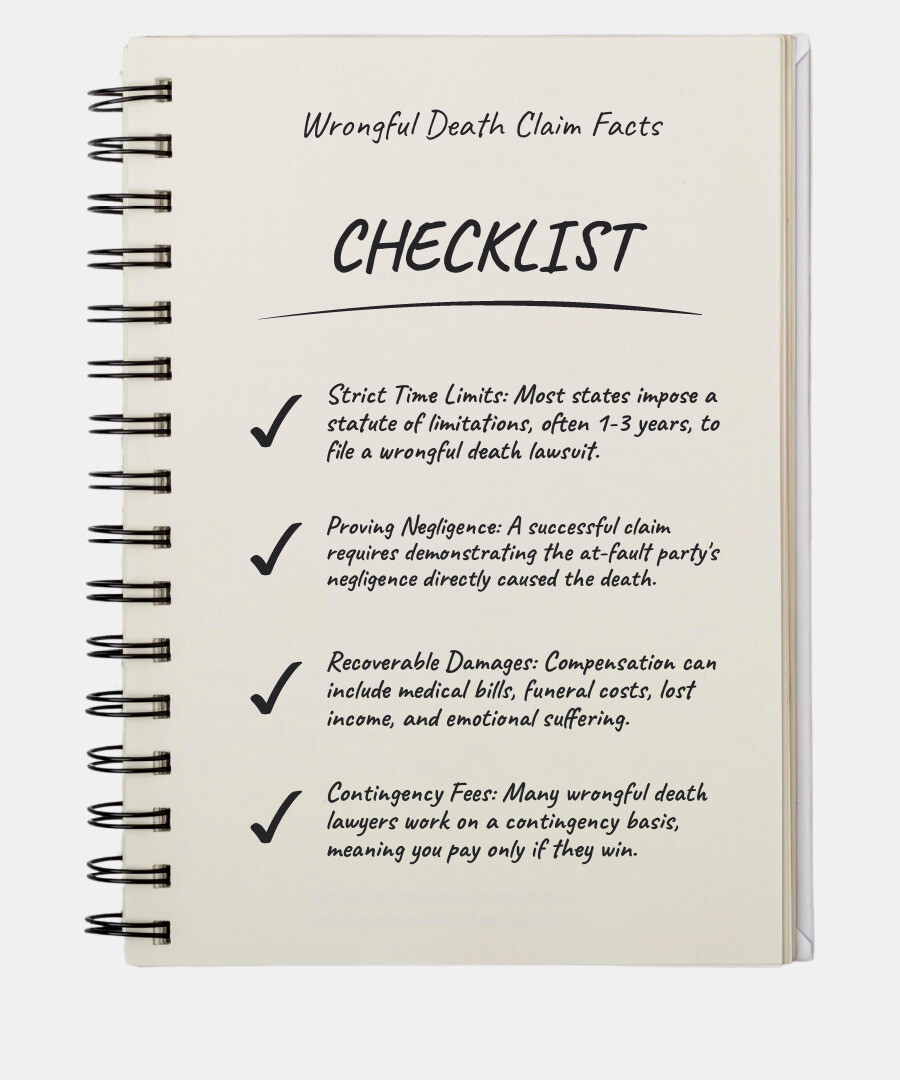
- What they recover: Economic damages (lost wages, medical expenses, funeral costs) and non-economic damages (loss of companionship, guidance, and care)
- Time limits: In Georgia, families typically have two years from the date of death to file a claim
- How they work: Most wrongful death attorneys operate on a contingency fee basis—no recovery means no fee
A wrongful death claim is a civil lawsuit, not a criminal case. Filed on behalf of the deceased’s family, it seeks to compensate survivors for the full value of the life lost and hold the negligent person or corporation financially responsible for the harm they caused.
Under Georgia law, these claims seek the “full value of the life of the decedent.” This includes tangible losses—such as lost income and medical expenses—and intangible losses like the loss of love, companionship, and guidance. In cases of egregious conduct, punitive damages may also be available to punish the wrongdoer.
The legal process is complex. Insurance companies and corporate defendants use aggressive tactics to minimize payouts. Families must prove negligence, establish causation, and quantify damages—all while grieving an irreplaceable loss.
This is why choosing the right legal advocate matters. A wrongful death lawyer with trial experience and a record of holding powerful defendants accountable can make the difference between a quick settlement and true justice.
When a life is cut short by another’s actions, the legal system provides a path to accountability. For families in Alpharetta, Atlanta, Johns Creek, Roswell, Sandy Springs, Duluth, and Marietta, Georgia, navigating the legal complexities is the first step toward securing justice.
Who Can File a Wrongful Death Claim in Georgia?
Georgia law is precise about who can file a wrongful death lawsuit, ensuring those most affected have the standing to seek compensation. The law follows a specific hierarchy to protect the immediate family’s interests.
In Georgia, the surviving spouse is the primary individual who can file. If there is a surviving spouse and minor children, the spouse represents the children. Any settlement or award is divided, with the spouse receiving at least one-third, ensuring both are provided for.
If there is no surviving spouse, the deceased’s minor children can file the claim. If there are no surviving children, the right falls to the deceased’s parents. Finally, if none of these family members exist, the personal representative of the deceased’s estate can file the lawsuit on behalf of the estate to recover damages.
Common Causes of Wrongful Death
A wrongful death lawyer handles cases arising from preventable negligent or intentional acts. Holding the responsible parties accountable is paramount.
Common causes of wrongful death cases in Georgia include:
- Car accidents: These frequent cases often result from distracted driving, speeding, or impaired driving. The negligent driver can be held liable.
- Trucking collisions: Accidents involving large commercial trucks are devastating. Negligence can stem from driver fatigue, improper maintenance, or trucking company safety violations.
- Medical malpractice: When healthcare professionals deviate from the standard of care, the consequences can be fatal. This includes misdiagnosis, surgical errors, or medication mistakes.
- Defective products: Manufacturers must ensure their products are safe. If a design flaw, manufacturing defect, or inadequate warning leads to a death, the manufacturer or distributor can be held accountable.
- Workplace negligence: Fatal accidents can occur due to an employer’s failure to provide safe equipment, adequate training, or proper safety protocols. A wrongful death claim may be pursued if a third party’s negligence contributed to the death.
- Premises liability: Property owners have a duty to maintain a safe environment. Deaths from slip-and-falls, inadequate security, or other hazardous conditions can lead to a claim.
The Anatomy of a Claim: Proving Negligence and Securing Justice
A successful wrongful death claim must prove four key elements. Your legal team must build an irrefutable case showing the defendant’s actions—or inaction—directly caused the death. This requires a relentless investigation to establish causation and uncover the truth.
The complexity of these cases often means going head-to-head with large corporations and their formidable legal teams. Cheeley Law Group approaches every case with a “trial first” strategy, preparing to expose negligence and demand accountability, no matter the opponent.
The Four Elements of a Wrongful Death Claim
To establish a successful wrongful death claim, a plaintiff must prove four fundamental elements. A wrongful death lawyer must demonstrate each one convincingly.
- Duty of Care: The defendant owed a legal duty of care to the deceased. This is the defendant’s responsibility to act with reasonable care to prevent harm, such as a driver operating a vehicle safely or a doctor providing competent care.
- Breach of Duty: The defendant breached that duty. This occurs when the defendant’s actions fall below the accepted standard of care, constituting negligence or a wrongful act, like a surgeon performing an incorrect procedure.
- Causation: The defendant’s breach of duty directly caused the death. This critical link must be proven, often with expert testimony, showing the defendant’s actions were a substantial factor in the death.
- Damages: The surviving family members suffered actual damages as a result of the death. These damages are the basis for the compensation sought in the lawsuit.
A wrongful death claim is a civil lawsuit, meaning its goal is to provide financial compensation to the victims, not to impose criminal penalties.
What Damages Can a Wrongful Death Lawyer Recover?
A wrongful death claim seeks compensation for the family’s profound losses. In Georgia, this is defined as the “full value of the life of the decedent,” covering both tangible and intangible harms. A skilled wrongful death lawyer carefully calculates these damages to ensure full recovery.
Economic Damages: These are quantifiable financial losses:
- Lost wages and benefits: The income the deceased would have earned, plus lost benefits like health insurance and retirement plans.
- Medical expenses: Costs for the deceased’s medical care from the time of injury until death.
- Funeral and burial expenses: The costs associated with the funeral and burial.
- Value of household services: The economic value of services the deceased provided, such as childcare or home maintenance.
Non-Economic Damages: These are profound intangible losses:
- Loss of companionship, care, and guidance: The loss of love, affection, comfort, and parental guidance.
- Pain and suffering of the surviving family members: The emotional distress, grief, and mental anguish experienced by those left behind.
Punitive Damages: Punitive damages may be awarded when the defendant’s conduct was egregious, reckless, or intentional. These damages are meant to punish the wrongdoer and deter similar conduct. In Georgia, they require clear and convincing evidence of willful misconduct, malice, fraud, or a conscious indifference to consequences.
Wrongful Death vs. Survival Actions
When a death is caused by another’s wrongdoing, two distinct legal claims may arise: a wrongful death claim and a survival action. While they stem from the same event, they serve different purposes and seek different damages.
| Feature | Wrongful Death Claim | Survival Action (Estate Claim) |
|---|---|---|
| Purpose | Compensates the deceased’s surviving family members for their losses due to the death. | Compensates the deceased’s estate for losses the deceased suffered before death. |
| Claimant | Designated beneficiaries (in Georgia: spouse, children, parents, or estate representative). | The deceased’s estate, typically filed by a personal representative. |
| Recoverable Damages | “Full value of the life of the decedent” (economic and non-economic losses of the survivors). | Damages the deceased could have claimed had they lived (medical expenses, lost wages, pain and suffering prior to death). |
| Focus | Loss to the living survivors. | Loss to the deceased and their estate. |
A wrongful death lawyer will evaluate the specifics of each case to determine which claims are appropriate. Often, both actions are filed concurrently to maximize recovery and ensure all aspects of the loss are addressed.
Navigating the Legal Process with a Wrongful Death Lawyer
The path from filing a claim to securing a verdict is a battle against insurance companies and corporate legal teams determined to minimize their financial exposure. An experienced lawyer manages every stage, from investigation to resolution, allowing the family to focus on healing.
Cheeley Law Group understands that confronting these powerful entities requires a “trial first” strategy. We prepare every case as if it will go to trial, ensuring we are always in a position of strength to fight for maximum recovery.
The Lawsuit Process: From Investigation to Verdict
The wrongful death lawsuit process is extensive and requires meticulous attention to detail. From the moment Cheeley Law Group takes a case, we employ a systematic approach to build an unshakeable foundation for justice.
- Investigation: This phase involves gathering all evidence related to the death, including police reports, medical records, autopsy reports, and witness statements.
- Evidence Gathering: We dig deeper by hiring expert witnesses—such as accident reconstructionists, medical professionals, or economists—to analyze facts and provide testimony.
- Filing the Lawsuit: Once sufficient evidence is compiled, a formal complaint is filed with the appropriate Georgia court, outlining the facts, legal basis, and damages sought.
- Findy Phase: During this formal information-gathering period, both sides exchange evidence through interrogatories (written questions), requests for documents, and requests for admissions.
- Depositions: Key witnesses, including the defendant and experts, are questioned under oath outside of court to gather crucial testimony.
- Settlement Negotiations: Throughout the process, a wrongful death lawyer engages in negotiations. While many cases settle, our “trial first” approach means we only accept settlements that reflect the full value of the family’s loss.
- Trial: If a fair settlement cannot be reached, the case proceeds to trial. We present evidence, examine witnesses, and make arguments before a judge and jury to compel a just verdict.
- Verdict and Compensation: If the jury finds for the plaintiff, a verdict is issued, and compensation is awarded.
The Role of Your Legal Advocate
A dedicated wrongful death lawyer acts as a relentless advocate, shouldering the legal burden so the family can focus on healing while navigating their grief.
The responsibilities of your legal advocate include:
- Expert Witnesses: Retaining highly qualified experts, from medical specialists to accident reconstructionists, to provide authoritative testimony.
- Accident Reconstruction: Orchestrating a detailed reconstruction of the event to scientifically prove how the death occurred and who was at fault.
- Dealing with Insurers: Managing all communication with insurance companies, protecting families from unfair tactics and ensuring their rights are upheld.
- Courtroom Advocacy: Vigorously representing the family in court, presenting evidence, and making compelling arguments to a judge and jury.
- Damage Calculation: Carefully calculating all damages to ensure the compensation sought reflects the full extent of the loss. For a deeper understanding, see How Compensation is Calculated.
- Emotional Support: Providing guidance and support, connecting families with resources, and offering a steady hand through a tumultuous time.
Potential Outcomes: Settlement vs. Trial
Most wrongful death lawsuits conclude with a settlement. However, the path to a just outcome is often determined by the legal team’s willingness and ability to go to trial.
Settlement advantages: A settlement can offer a faster resolution, reduce the emotional toll, and provide a guaranteed financial outcome. A strong legal position, built on a “trial first” strategy, often compels defendants to offer fair settlements.
Trial necessity: Sometimes, defendants refuse to offer fair compensation. This is where Cheeley Law Group’s “trial first” strategy is paramount. We are not afraid to confront powerful corporations in court. Our dedication to corporate accountability means we are prepared to present a compelling case to a jury, seeking a verdict that not only compensates the family but also sends a clear message. Our record-setting verdicts demonstrate our commitment to securing justice. Past results do not guarantee future outcomes.
Critical Deadlines and Common Challenges
Georgia law imposes a strict deadline for filing a wrongful death lawsuit, known as the statute of limitations. Families typically have only two years from the date of death to file a claim. Missing this deadline forfeits the right to seek justice, making immediate legal consultation critical.
The period following a wrongful death is characterized by overwhelming grief, yet this is when critical legal decisions must be made. The clock starts ticking from the date of death, making prompt action indispensable.
Georgia’s Statute of Limitations
The statute of limitations is a legal deadline within which a lawsuit must be filed. In Georgia, the standard deadline for a wrongful death claim is two years from the date of the deceased person’s death. Failure to file within this period almost always results in the permanent loss of the right to pursue a claim.
While the two-year rule is standard, exceptions can alter this period:
- Findy Rule: In limited circumstances, if the cause of death was not immediately apparent, the “findy rule” may apply. This means the clock starts when the cause of death was or should have been finded. This exception is rare in wrongful death cases.
- Claims Against Government Entities: If the claim is against a government agency in Georgia, the deadline to file a notice of claim can be much shorter—sometimes as little as six months—before a lawsuit can be filed.
- Minors: If the beneficiaries are minors, the statute of limitations may be paused (tolled) until they reach the age of majority, though an adult representative typically files the claim.
Given these complexities, it is imperative to consult an experienced wrongful death lawyer in Georgia as soon as possible to preserve all rights and meet every deadline.
Common Problems Families Face
Beyond the emotional devastation, families face significant legal and practical challenges that can feel impossible without experienced legal guidance.
- Proving Causation: Establishing a direct link between the defendant’s actions and the death is a significant challenge, often requiring expert testimony to reconstruct events.
- Insurance Company Tactics: Insurance adjusters will try to settle cases quickly for minimal amounts or deny liability altogether. A wrongful death lawyer understands these tactics and protects families from being taken advantage of.
- Multiple Defendants: In complex cases, multiple parties may share responsibility. Identifying all liable parties and pursuing claims against each requires extensive legal expertise.
- Emotional Toll: The legal process is arduous and can be emotionally draining for grieving families. A compassionate legal team handles these burdens, allowing families to focus on healing.
- Valuing the Loss: Quantifying the “full value of the life of the decedent” is complex. It involves financial projections for lost income and assigning a monetary value to intangible losses like companionship, requiring the expertise of economists and other specialists.
For more information on the broader context of legal claims involving injuries and losses, refer to our Personal Injury practice area page.
Choosing the Right Advocate for Your Family

When the stakes are this high, your choice of legal representation is paramount. You need a champion with the resources, experience, and tenacity to take on powerful opponents and win. The right firm is not intimidated by corporate giants and prepares every case for trial from day one.
Cheeley Law Group, with its “trial first” strategy and a history of securing over $1.3 billion in verdicts and settlements, stands as a relentless champion for families in Georgia. Our approach is to outwork, outthink, and out-prepare the opposition to ensure justice is served. Past results do not guarantee future outcomes.
How to Choose the Right Wrongful Death Lawyer
Choosing a wrongful death lawyer is a critical decision. Avoid firms that prioritize quick, low settlements over true justice. Your family needs an advocate with a proven track record of fighting for the full value of a claim.
Key factors to consider when choosing your legal representation:
- Trial Experience: Prioritize firms with extensive courtroom experience and a history of taking complex cases to trial. Cheeley Law Group’s “trial first” strategy means we are always prepared to fight for a verdict.
- Verifiable Results: Demand proof of success in significant cases, particularly against large corporations. While past results do not guarantee future outcomes, a track record of substantial verdicts demonstrates a firm’s capability.
- Contingency Fee Structure: Reputable wrongful death lawyers work on a contingency fee basis, meaning the family pays no upfront fees. The lawyer is paid only if they secure compensation. For a detailed explanation, visit Contingency Fee Explained.
- Resources for Complex Cases: These cases require significant financial and investigative resources for expert witnesses, accident reconstruction, and extensive findy. Ensure the firm has the capacity to fund and manage these demands.
- Personal Attention and Compassion: While tenacity is crucial, so is empathy. A good wrongful death lawyer provides compassionate guidance and personalized attention, understanding the immense emotional toll on the family.
Questions to Ask a Potential Attorney
When interviewing potential wrongful death lawyers, ask direct questions to assess their suitability for your family’s case.
Consider asking:
- What is your experience with wrongful death cases specifically in Georgia? Understand their familiarity with Georgia’s laws and courts.
- What is your firm’s trial record in similar cases? Inquire about their experience taking cases to verdict, not just settling them.
- What resources does your firm have to handle a complex case? Ask about their access to expert witnesses, investigators, and financial capacity.
- How will communication work throughout the process? Understand how often you will receive updates and how to reach your legal team.
- How do you approach settlement negotiations versus preparing for trial? A firm that prioritizes trial preparation often achieves better outcomes.
- What are your fees, and how do they work? Confirm the contingency fee arrangement and any potential expenses.
Securing Justice for Your Family
While no legal action can undo the tragedy of losing a loved one, it can provide the accountability and financial stability needed to move forward. A wrongful death claim is a powerful tool for exposing negligence and holding those responsible to account. The legal team at Cheeley Law Group, led by Robert D. Cheeley, has a long history of securing justice for families. If your family is facing such a loss, we are here to help you understand your rights. Past results do not guarantee future outcomes.
At Cheeley Law Group, we stand ready to be the relentless champion your family needs. We are prepared to go toe-to-toe with the largest corporations, fighting for every dollar of compensation you deserve. Our “trial first” strategy, combined with our deep understanding of Georgia law, ensures that we are always prepared to secure justice.
Schedule your confidential consultation to learn how we can help. Contact Us