
Understanding the Lawsuit Settlement Process: Why Most Cases Never Reach a Courtroom
The lawsuit settlement process is how most civil cases reach resolution without a jury verdict. Instead of risking the unpredictability of trial, parties negotiate terms that resolve the dispute—often achieving accountability without the time, cost, and uncertainty of a courtroom battle.
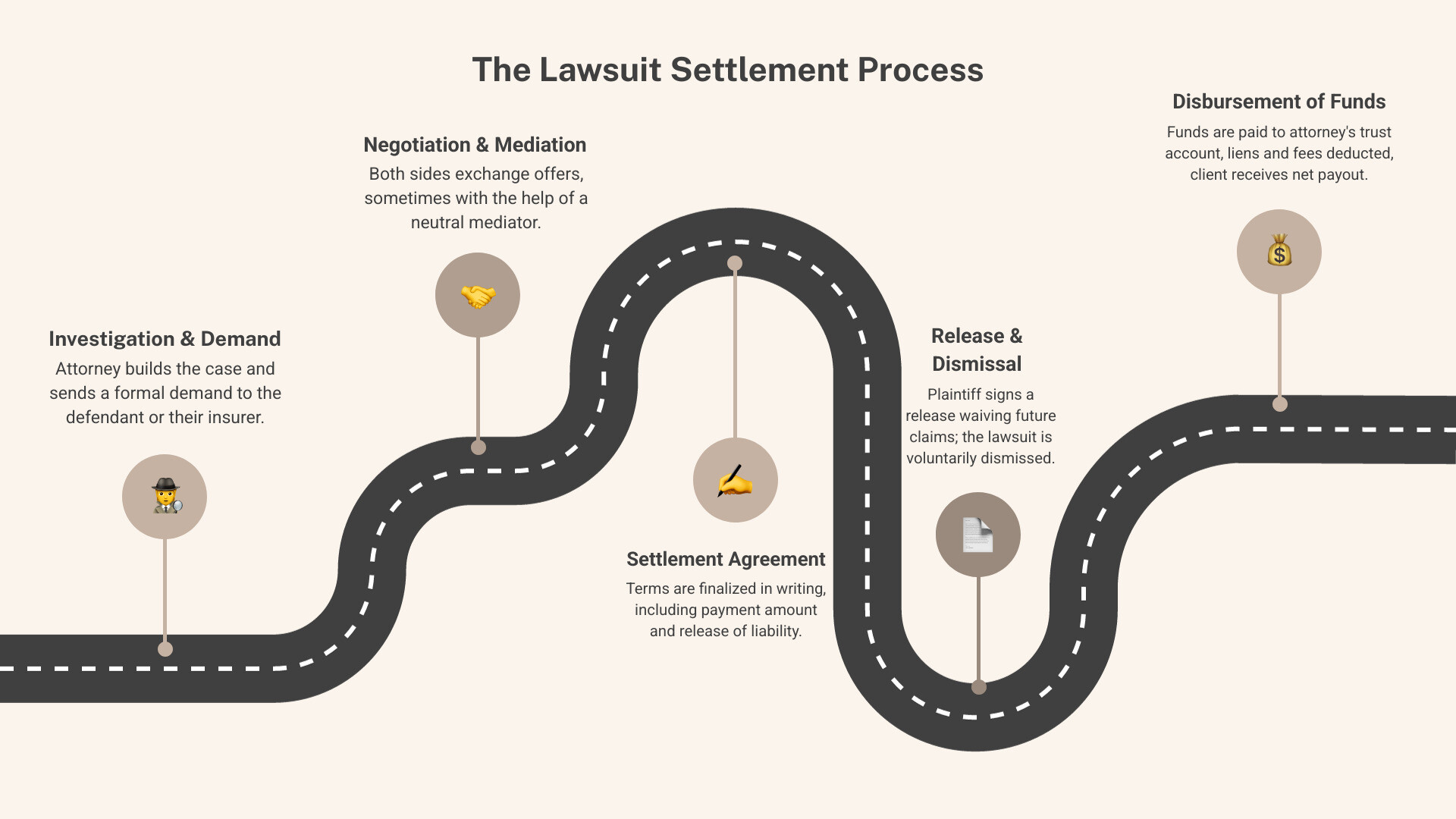
Here’s how a lawsuit typically settles:
- Investigation & Demand — Your attorney builds the case and sends a formal demand to the defendant or their insurer
- Negotiation & Mediation — Both sides exchange offers, sometimes with the help of a neutral mediator
- Settlement Agreement — Terms are finalized in writing, including payment amount and release of liability
- Release & Dismissal — The plaintiff signs a release waiving future claims; the lawsuit is voluntarily dismissed
- Disbursement — Funds are paid to your attorney’s trust account, liens and fees are deducted, and you receive the net payout
Only 4% of personal injury cases go to trial. The rest settle—because both sides recognize that resolution can be faster, more certain, and less costly than litigation.
But settlement is not surrender. It’s a strategic tool. When your attorney approaches negotiations from a position of trial readiness—armed with evidence, expert testimony, and a credible threat of courtroom accountability—the defendant’s posture changes. Corporations and insurance companies don’t write checks out of goodwill. They respond to pressure.
Settlement also offers control. You decide whether the offer is acceptable. You avoid the risk of a defense verdict. And in many cases, you can keep the terms confidential—protecting your privacy while securing the compensation you need to rebuild your life.
Understanding the settlement process means understanding when to settle, how settlements are valued, and what happens after you sign. It means knowing the difference between a fair resolution and a lowball offer designed to close your case cheaply.
This guide walks you through every stage of the lawsuit settlement process—from the first demand letter to the final disbursement. You’ll learn how cases are valued, what terms to expect in a settlement agreement, how attorney fees and medical liens are handled, and what happens if a settlement falls through.
Whether you’re facing catastrophic injury, wrongful death, or corporate negligence, the settlement process is where justice is negotiated. And negotiation without leverage is just conversation. A trial-ready attorney turns that conversation into accountability.
Why Settle? The Strategic Decision to Resolve a Case Before Trial
The decision to settle a lawsuit is rarely simple. It involves a complex calculus of risk, reward, and the very human desire for closure. While the image of a courtroom battle captures public imagination, the reality is that the vast majority of personal injury cases, and civil disputes in general, are resolved outside the courtroom. This resolution, known as a settlement, is a mutual agreement between the parties to end the dispute.

According to the Bureau of Justice, a staggering 96% of personal injury cases settle out of court by mutual agreement between the parties.
This widespread preference for settlement over trial speaks volumes about the strategic advantages it offers to both plaintiffs and defendants. The core reasons behind this trend revolve around the desire for certainty, the prohibitive cost of litigation, the extensive time commitment involved in a trial, and the inherent privacy of a negotiated outcome.
Advantages of Settlement
For the injured party, a settlement offers a guaranteed recovery. Unlike a trial, where the outcome is always uncertain, a settlement provides a definitive sum to compensate for losses. This certainty can be invaluable, especially when facing mounting medical bills, lost wages, and the long-term financial strain of a catastrophic injury. It avoids the agonizing wait for a jury verdict, which could deliver nothing.
Settlements also allow plaintiffs to avoid the immense stress and emotional toll of a public trial. Preparing for and enduring cross-examination, reliving traumatic events, and facing the defendant in court can be mentally exhausting. A settlement offers a faster resolution, allowing individuals and families to move forward with their lives without the prolonged anxiety of litigation. Furthermore, settlements often include confidentiality clauses, keeping the details of the agreement private, which can be important for personal privacy.
Disadvantages of Settlement
However, settlements are not without their drawbacks. One significant disadvantage is the potential for a lower financial award compared to what a sympathetic jury might grant. Insurance companies, driven by profit, often initiate settlement discussions with lowball offers, aiming to resolve cases cheaply. Without a relentless advocate prepared to take the case to trial, a plaintiff might unknowingly accept less than their case is truly worth.
Another disadvantage is the lack of a “public day in court.” For some victims, the process of a trial, including public testimony and a jury’s verdict, offers a sense of vindication and justice that a private settlement cannot. Finally, most settlement agreements include a clause stating that the defendant does not admit fault or liability, even when paying substantial compensation. This can be unsatisfying for plaintiffs seeking a formal acknowledgment of wrongdoing. Understanding the nature of personal injury law is crucial in weighing these factors.
The Anatomy of a Settlement: How a Claim is Valued
Before any meaningful negotiation can begin, a claim must be thoroughly valued. This process is complex, involving a meticulous assessment of all damages incurred by the plaintiff. The goal is to quantify not just the immediate losses, but also the long-term impact of the injury on the victim’s life.

Damages in a personal injury case typically fall into several categories. Economic damages are quantifiable financial losses, such as past and future medical expenses, lost wages, loss of earning capacity, and property damage. These are often proven with bills, pay stubs, and expert vocational assessments. Non-economic damages are more subjective and compensate for intangible losses like pain and suffering, emotional distress, disfigurement, and loss of enjoyment of life. While harder to quantify, these damages are a critical component of a claim’s value, especially in catastrophic injury cases.
In rare instances, punitive damages may be sought. These are not intended to compensate the victim but to punish the defendant for egregious conduct and deter similar actions in the future. Their availability and amount depend heavily on the specifics of the defendant’s negligence and are often a significant factor in high-stakes litigation.
The valuation of a claim is also heavily influenced by liability. Is the defendant clearly at fault, or is there disputed liability? The stronger the evidence proving the defendant’s negligence, the higher the potential settlement value. The strength of evidence—including medical records, police reports, witness statements, accident reconstruction, and expert testimony—directly correlates with the leverage a plaintiff’s attorney has in negotiations. Cheeley Law Group, a Georgia-based firm, understands how to calculate compensation and present compelling evidence to maximize recovery.
Finally, insurance policy limits play a practical role. While the value of a claim might exceed these limits, the available insurance coverage often sets a ceiling for what an insurer is willing to pay in a settlement. A skilled attorney will investigate all potential sources of recovery to ensure the claim’s true value is pursued. Insurance companies, as detailed by AllLaw, employ various tactics to determine and often minimize their settlement offers, making a knowledgeable advocate indispensable.
The Lawsuit Settlement Process: From Negotiation to Final Payout
The journey from initial injury to final settlement payout is a structured, multi-stage process. It begins with strategic demands and intense negotiations, progresses through formal agreements, and concludes with the meticulous disbursement of funds. Each stage requires careful attention to detail and a relentless pursuit of the client’s best interests.
Stage 1: The Negotiation Phase of the Lawsuit Settlement Process
The lawsuit settlement process officially kicks off with the demand letter. After thoroughly investigating the incident, gathering all evidence, and calculating damages, your attorney will send a comprehensive demand letter to the defendant or their insurance company. This letter outlines the facts of the case, the extent of your injuries and losses, and a specific monetary demand for settlement.
From there, the negotiation truly begins. Insurance adjusters, representing the defendant, are often trained to employ various tactics to minimize payouts. They may offer a low initial sum, hoping you’ll accept it quickly, or try to get you to provide a recorded statement before you’ve fully understood your legal rights. It is crucial never to give a recorded statement to an insurance company without first consulting an attorney. A seasoned attorney understands these tactics and will protect your interests.
The negotiation phase involves a series of offers and counteroffers exchanged between the parties. This back-and-forth can be direct or, more commonly, facilitated through mediation. Mediation involves a neutral third party, a mediator, who works with both sides to explore potential compromises and guide them toward a mutually acceptable resolution. The mediator does not decide the case but helps facilitate communication and understanding.
The attorney’s role in these negotiations is paramount. They not only present your case compellingly but also manage your expectations, advise on the fairness of offers, and maintain a firm stance against lowball proposals. This includes understanding the nuances of how the negotiation process works in injury cases, leveraging every piece of evidence to secure maximum compensation.
Stage 2: Finalizing the Agreement and Signing the Release
Once both parties reach a mutually agreeable figure, the terms are formalized in a settlement agreement. This is a legally binding contract that details the responsibilities of each party, the total settlement amount, and the terms of payment. According to Cornell Law, a settlement is an agreement that ends a dispute and results in the voluntary dismissal of all related litigation.
A critical component of this stage is the release document. This document, often referred to simply as the “release,” essentially formalizes the agreement and acts as a contractual promise that you will not pursue further legal action related to your injuries once the settlement is finalized. The American Bar Association emphasizes the importance of this document, as signing it typically waives your right to any future claims arising from the incident. It is imperative that you review this document thoroughly with your attorney to ensure it accurately reflects the agreement and protects your rights.
Settlement agreements often include confidentiality clauses, prohibiting either party from discussing the terms publicly. Additionally, a standard provision is no admission of guilt by the defendant. Even if a substantial settlement is paid, the defendant typically does not formally admit wrongdoing. Upon signing the release and fulfilling any other conditions, the lawsuit is then subject to voluntary dismissal, formally removing the case from the court’s docket.
Stage 3: The Payout and Disbursement of Funds
After the settlement agreement and release are signed, the payment process begins. The settlement funds are typically sent to your attorney’s trust account (also known as an escrow account). This ensures the funds clear properly and can be managed ethically.
From this gross settlement amount, several deductions are made. First are the attorney fees. In most personal injury lawsuits, attorneys work on a contingency fee basis, meaning they receive a percentage of the total recovery. This is usually between 33% and 40% of the total amount. Cheeley Law Group explains the contingency fee structure to ensure transparency.
Next, case costs are reimbursed. These are expenses incurred during litigation, such as filing fees, expert witness fees, court reporter costs for depositions, and the cost of obtaining medical records. Finally, any outstanding medical liens or other financial obligations related to your case are resolved. This includes payments to healthcare providers who treated you, or potentially to government agencies like Medicaid or Medicare if they covered your initial medical expenses. Resolving liens on your medical care is a crucial step before final disbursement.
Only after all fees, costs, and liens are satisfied will the net payout be disbursed to you, the client. While the insurance company may issue the check within days of the agreement, the entire disbursement process, including lien negotiations and fund clearing, can take several weeks, sometimes up to six weeks or more after signing the release.
Common Delays in the Lawsuit Settlement Process
Even after an agreement is reached, various factors can cause delays in receiving your funds. Disputes over the precise language of the release form can hold up the process, as both sides scrutinize every word. Complex lien negotiations with multiple medical providers or government entities can also be time-consuming, requiring detailed reconciliation.
Insurance company bureaucracy is another common culprit. Internal processing, interstate payment protocols, or even clerical errors can slow down the issuance and transfer of funds. Finally, cases involving minors or wrongful death often require court approval for settlements, adding an extra layer of judicial review designed to protect vulnerable parties, which can extend the timeline.
Understanding Your Payout: Lump Sum vs. Structured Settlements
Once a settlement amount is agreed upon, a critical decision remains: how will the funds be paid? You generally have two primary options: a lump sum payment or a structured settlement. The choice depends heavily on your financial needs, long-term goals, and the nature of your injuries.
| Criteria | Lump Sum Payment | Structured Settlement |
|---|---|---|
| Access to Funds | Immediate full access to entire settlement amount. | Periodic payments over a set period or lifetime; partial immediate payment possible. |
| Financial Management | Full responsibility for managing and investing funds. | Managed by a third-party annuity provider; less direct management required. |
| Long-Term Security | Risk of quickly depleting funds; potential for poor investment choices. | Guaranteed income stream; protects against premature depletion; long-term financial stability. |
| Tax Implications | Generally tax-free for physical injury, but interest/punitive damages are taxable. | Periodic payments for physical injury often tax-free; can offer significant tax advantages. |
A lump sum payment provides the entire settlement amount in a single payment. This offers immediate access to funds, giving you complete control over how the money is used. For some, this means paying off debts, making necessary purchases, or investing in a way they see fit. It provides immediate financial relief and flexibility.
However, a lump sum also places the entire burden of financial management on the recipient. Without careful planning and professional advice, there’s a risk of depleting the funds prematurely or making poor investment decisions.
In contrast, a structured settlement involves receiving payments in installments over an agreed-upon period, which can span several years or even your lifetime. These payments are often funded through an annuity purchased by the defendant. The Free Dictionary describes a structured settlement as sending regular payments for a set period until the liable party has fully covered your losses.
Structured settlements are particularly appropriate for catastrophic injuries that require long-term medical care, ongoing living expenses, or for individuals who may struggle with managing a large sum of money. They offer financial stability and peace of mind, ensuring a steady income stream. Moreover, structured settlements can provide significant tax advantages, as the periodic payments for physical injury are often tax-free. The downside is the lack of immediate access to the entire sum, which can be restrictive for those with urgent, large expenses.
Special Considerations and Post-Settlement Issues
The lawsuit settlement process doesn’t always end cleanly with a signed check. Sometimes, complications arise, or different types of cases demand unique considerations. Understanding these nuances is crucial for navigating the legal landscape effectively.
What Happens if a Settlement is Breached?
A settlement agreement is a legally binding contract. If one party fails to uphold their end of the bargain—for instance, if the defendant fails to make a promised payment—it constitutes a breach of the agreement.
In such a scenario, the injured party’s attorney can take action to enforce the agreement. This might involve filing a motion to enforce with the court that originally handled the case, asking the judge to compel compliance. If the original case has already been dismissed, enforcing the settlement can become more complex, sometimes requiring a new breach of contract action to be filed. The court’s intervention is often necessary to ensure the terms are honored, underscoring the importance of having a clear, written agreement and legal counsel to pursue enforcement.
How Class Action Settlements Differ
Class action lawsuits differ significantly from individual personal injury cases. In a class action, a group of individuals with similar claims against a defendant band together, and a single lawsuit is filed on behalf of the entire “class.” Cornell Law defines a class action as a procedural device that permits one or more plaintiffs to file and prosecute a lawsuit on behalf of a larger group.
The court approval process for class action settlements is much more rigorous. A judge must grant both preliminary and final approval, ensuring the settlement is fair, reasonable, and adequate for all class members. A neutral settlement administrator is typically appointed to manage the complex tasks of notifying class members, processing claims, and distributing funds.
Class members usually have opt-out rights, allowing them to exclude themselves from the settlement and pursue their own individual claims if they believe the class settlement is insufficient. However, individual payouts in class actions are often lower than what might be achieved in an individual lawsuit, due to the sheer number of claimants. Furthermore, these cases can be protracted, sometimes going on for 5 to 10 years, especially in multidistrict litigation involving hundreds or thousands of people.
Potential Tax Implications of a Settlement
The tax treatment of settlement funds is a critical aspect that many overlook until it’s too late. It is imperative to consult with a qualified tax professional regarding your specific settlement, as the rules can be complex and depend on the nature of the damages awarded.
Generally, compensation for physical injuries or sickness in personal injury cases is not considered taxable income. This includes amounts received for medical expenses, pain and suffering, and emotional distress directly related to the physical injury.
However, other components of a settlement are typically taxable. Punitive damages, designed to punish the defendant rather than compensate the plaintiff, are almost always taxable. Similarly, amounts received for lost wages or lost profits are usually treated as taxable income. Any interest accrued on a settlement award is also subject to taxation. Given these complexities, seeking the advice of a tax professional is non-negotiable to understand your obligations and avoid unexpected tax liabilities.
Securing Justice Requires a Relentless Advocate
The lawsuit settlement process is not merely a series of forms and deadlines; it is a strategic battleground where accountability is negotiated. For victims of catastrophic injury, wrongful death, or corporate negligence, securing a fair settlement is not just about financial recovery—it’s about holding powerful entities accountable for their actions.
Corporations and insurance companies do not yield out of kindness. They respond to strength. When faced with an attorney who is not only skilled at negotiation but also genuinely prepared to take a case to trial, their posture shifts. A credible threat of courtroom accountability forces them to value a case properly, often leading to a more favorable settlement. This “trial first” strategy is what defines Cheeley Law Group, a Georgia-based firm known for its tenacity and “Southern grit.”
Cheeley Law Group specializes in high-stakes personal injury, wrongful death, and business litigation, securing record-setting verdicts against formidable corporations. The firm’s relentless pursuit of truth and uncompromising fight for justice has resulted in over $1.3 billion in verdicts and settlements for clients. Past results do not guarantee future outcomes, but they demonstrate a commitment to securing justice when the stakes are life-changing.
If you or a loved one has suffered catastrophic harm due to another’s negligence, you need more than just a lawyer—you need a relentless champion. You need an advocate who understands that negotiation without leverage is just conversation. You need a firm that goes toe-to-toe with the largest corporations, exposing negligence and demanding accountability.
Accountability is non-negotiable.
Schedule a Consultation to Discuss Your Personal Injury Claim